A Day to Weep

I am reminded of something extraordinary almost everyday whenever I utilize the internet. Depression thrives in the bodies of the forgetful. It’s no wonder that we covenant to remember. Sometimes, no matter where I am, I stop what I’m doing and take great pause in the fact that I have a near endless array of information all before me. It’s in the very air, it seems. With a few clicks I can have any book I want. In a couple of moments I can learn about any topic. With some hard work I can pursue and excel in any field. And with a tilt of my head I have the stars in their endless glory, ever stirring wonder and stoking the fire of my imagination. 


Depression has plagued me for nearly as long as I can remember and it has caused my spirit great fatigue, yet, because of it I have learned to see through glasses of grey, and I have been obliged to look at the world in a unique light. I count it as a blessing because so thoroughly, so unendingly and unceasingly it has reminded me that this place is not only beautiful but also filled with endless opportunity to stretch my mind in pursuit of some previously unknown truth. I have the near entire body of human knowledge before me, I have a voice to share my thoughts, I have a universe to learn from and a world to influence the ways in which I see appropriate, and I have friends and family moments away, no matter where I am. Perhaps the hardest thing isn’t doing without, but learning to see the immense good that floods over our lots daily and what on earth we are to do with it all.


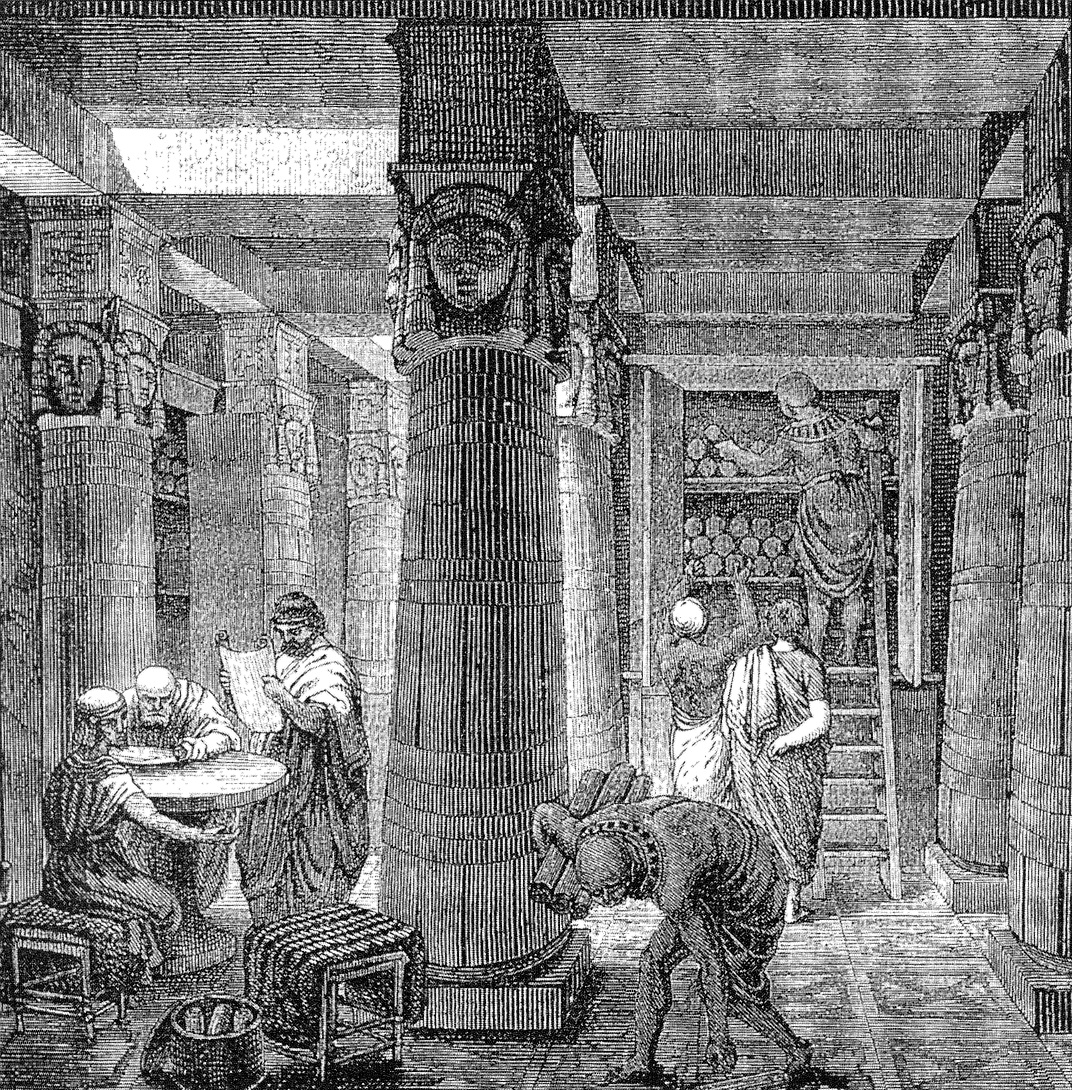
Since the day I learned of the great Library of Alexandria and the destruction that befell it, I have steadily gained greater appreciation for information and the mediums it is transmitted in. I am inspired and filled with amazement by those, who in ancient times, traveled from around the world to study in its great rooms filled with papyrus scrolls and codices—Euclid, Eratosthenes, and Hypatia to name a few. I’ve wondered where we, as humans of planet Earth, would be at this time had not such a devastating fire swept through its rooms and destroyed an unknown amount of precious information. In truth I’ve often found myself quite indignant that we aren’t spreading throughout the solar system by now. Just think where we could be culturally and scientifically had such an immense loss of literature somehow been prevented. I am filled with wonder and regret whenever I read the work of ancient authors who cite other authors and use information which can be traced back to The Library, but otherwise remains inexistent. I’d say it’s near unfathomable to begin to attempt to predict where we could be, as I’m sure that not one person could have known such an advance in technology within the last few hundred years would have happened the way it did, and even within the last twenty. We may not be able to predict what the next great invention will be or what societal injustice will be blotted out of our moral landscape because of the hard work of concerned men and women of this great world. But surely we can continue to act in such a way that allows for the exponential growth of knowledge, compassion, and justice, allowing the seeds of inspiration to blossom in their ever unique and magnificent ways.


How can it be that I, quite the average person, sit here typing away on an expensive laptop, worrying about what kind of food I’d like to eat in the next hour, comfortable in my room with the ability to travel to any place in the world within 24 hours should I so decide while there remain people starving in countries where clean water is a precious resource. With all of the vices and mind numbing plots plaguing the internet and despite its near endless supply of cat videos, it is, indeed, quite the miracle that empowers almost everyone. How can there be, for all intents and purposes, millions if not billions of individuals who currently live better than most Kings and Royalty throughout history and still live in a world where people lack the most basic essentials for life. Have we not taken everything we have for granted? I dread the day that we are humbled. Should our modern day Library of Alexandria go offline, how many of us would weep, not for the loss of our entertainment, or for the vices that have a stranglehold over our hearts, but of the near entire body of human knowledge and the power that that knowledge endows? It would be a day to weep.

Heaven 1 to Stranger Things (Life Overview)

Life Overview


Heaven 1


Believe it or not I am constantly working on this story. If I’m not feverishly writing backstory I am thinking about it and discussing plot points with a few privileged individuals. It is easier to write backstory than to write a chapter that you expect other people to read. I am about half way through chapter two which is tentatively called A Conversation with a God . So, stay tuned. 


Oh, how I wish I could post about where this story is going. But I can’t. You’ll just have to be patient. Heaven 1 is the playground of my imagination that I am trying to solidify. It is the realization of my epic childhood sagas. I feel that this story will keep me busy for years to come. My apologies for the slow going, though. It takes a lot of energy. But I can’t tell you how fulfilling it is to know that I’ve suspended even just a few people in wonder at what will happen next. It makes me smile. I am selfish. What can I say.


School


Well, Fall Semester started today. That means I passed three classes this Summer. Believe it or not, that is a major life win. School is still something that I do with gritted teeth and despite the cells of my body urging me to surrender. It is a war that I have determined to win. Even that said, every time I walk into a new class I am filled with excitement with what I will learn, albeit stressful, often.


After Fall semester I’ll be done with my Generals and my Global Intercultural Requirement, but I’ll be flat broke with the bulk of my Physics Core before me. I’m thinking about just focusing on an associates for the time being. It’s something a little more attainable. 


The obligation I feel to school is one that is best described in metaphor. The light of the moon caresses the dark valleys and blesses them with a unique tone, one that will forever stand poetic and resonant with the soul. But it’s beauty remains differentiated from the brilliant light of the sun at midday. It shines bright as an afterthought. My character, my mind, and my soul benefit from this experience. They do. But school is still dark, and the areas that have yet to be lit hide from my view and cause my tread to be driven forward by nothing but faith, and hope that I can feel like this will all be worth it in the end. I know it will. But it is the challenge of my lifetime. I know those areas are there. They are there waiting to be found like the pretty shells washing up upon Newtons shore. What more reason is there to pursue school?


The ground that I need to make up, however, seems insurmountable. I feel inadequate. I feel lost. I feel incapable. I feel like it is an unrealistic goal that detracts from other more important things. And I sigh. The smallest things offer the most significant motivation to continue forward.


Books


My collection grows faster than what I can read. I’ve had to seriously dial back my Amazon purchase recently so I can focus on what I already have. My bedroom floor is covered in books. I pick one up every night and read what I can before I go to sleep. Book marks consist of math homework, Finding Faith in Christ pass along cards, Smith’s receipts, and other things that I find on my floor. 

I’m almost done with The Alchemist. It is a nice book. I appreciate the spirit it has. I’ve been trying to get through Steven Pinker’s The Stuff of Thought, but it is the most difficult book I have undertaken. It deals mostly with how children learn the semantics and nuances of spoken language giving example after example of how children tend to speak contrasted with how adults typically speak. It addresses the question of tabula rasa, that is the blank slate as opposed to innate ideas and how either one of those possibilities translates into verbal communication. It is like grinding a brick on my forehead. 


I’ve got the Smithsonian’s Timeline of Science always near. I peruse it almost nightly. There is The Death of the Heart, which I have just started, mainly because I wanted to see what people think is good writing. Well, that’s all for books. 


TV


Okay. Awkward eighties kids, government conspiracies, synth music, monsters, and Winona Ryder. I have something new I can love in Netflix’s Stranger Things. I haven’t had to bum Netflix from someone since Prison Break. The only problem now is that it’s already over. Ugh. 


I want to say a few things about this show. Firstly, I love it. It makes me happy. I watched the first season and I had only three complaints. But after some further investigating I now only have two. 


Ok, surely you’re familiar with Stranger Things by now. But all the same. SPOILERS.


Let me explain. One of the coolest scenes is when Eleven kills all of those agents toward the end of the show with her powers. The paralyzed agents with blood oozing out of their eyes right before they drop over dead all in unison reveals just what El is capable of. But. And it’s a big but. It could have been SO much better if, up until that time, we had only a sparse showing of her powers that hinted as to what she could actually do. My biggest complaint is that her powers were overused. She already killed two agents in the first episode, she makes the kid pee his pants, she breaks the glass doors, she flips a van over her head, she saves Mike from falling to his death, she breaks that kids arm, she force pushes Lucas into the air, she creates the portal to The Upside Down, among many other instances. All of these things preceded the awesome but totally predictable scene where she kills all those agents at the end. Her powers are radical without a doubt (yes, I just intentionally used the word “radical” to mean “cool” and there is nothing you can do about it.) But it needed to be toned down, if only to make that agent scene so much more impactful. That said, Millie Bobby Brown is perfect. All the actors are great, but she knocks it out of the park.


My second complaint was purely aesthetic. The monster looks stupid. That is about all it sums up to. And their early description of it made me think of slender man, which made me roll my eyes. Hard. A tall human with no face. I don’t have anything else to say about it.


Finally, the most frustrating thing to me was something I thought after an initial viewing of the show. I was upset that both the main villains were killed off at the end, Dr. Martin Brenner, and Agent Connie Frazier. Despite their dark roles they were both good characters, and to kill both of them off was a little perturbing. However, I watched the scene when the monster jumps on Brenner a few more times and it doesn’t necessarily mean he is dead. It doesn’t explicitly show him die. But, you’re saying, most likely it does, right? Well, I looked a little harder. And this might be a SPOILER even to those who’ve watched the show already. Near the end of the final episode, right after the scene where Nancy gives Johnathan a new camera it cuts to a scene at the police station where Hop and his crew are celebrating Christmas. The scene transitions onto a newspaper clipping pinned up on a cork board talking about “THE BOY WHO CAME BACK TO LIFE” and, I took the time to read the article. It has some really interesting things in it, but, perhaps the most interesting is the last sentence. It reads “Under legal [advice] Brenner has issued no comment on…” So, Brenner is alive. That is that. And it’s good to know.


Last thing. I wanted to say something about Nancy ending up with Steve after it was all over. Most everyone I know didn’t like it. But, I did, actually. Not only did Steve redeem himself, but he is an overall likable character despite his shortcomings. I feel like it would have been playing too far into cliche if Nancy ended up with Johnathan at the end. It was more realistic the way it happened, and it was a nice change to see that the underdog didn’t necessarily have to end up with the girl. Johnathan is still a badass who whooped Steve! In its own right, the ending elicits an unspoken affection between Nancy and Johnathan, which is character expanding and deeply moving.


All of that said. Season two is in the works. And who knows what will come of their relationship. Obviously Eleven isn’t dead, too, Hop is privy to otherwise unknown secret government information because he struck a deal with the devil, or something like that. And, oh yeah. Barb. She’s totally dead. Maybe this is a fourth complaint. We are never given so much as a glimpse of her mourning parents. Other than a couple distraught looks from Nancy Barb dying was completely glossed over at the end. But I guess they didn’t want to detract too much from the primary purpose of the show, that of saving Will. But, I guess, you know, it’s whatever…


Well. That’s all I want to write about. What does it say that half of this post is about Stranger Things? Looking forward to season 2. And looking forward to being excited about a TV show. That is all.


P.S. Are Netflix originals considered TV? Is there a word for those shows? I was just assuming they are but I have no idea.

Pigeons, Angels, and The Like

I watched the sunrise this sabbath morning. I spent those few moments enjoying the theater of nature—something I haven’t taken the time to do for awhile. The clouds, arching over the peaks of the mountain carried a tinge of grey but after a few blinks I began to see the lines of sun bursting through their lackluster air. It turned their gloom into several vivid tones of orange and yellow. As I was fixed on the exceptional scene a bird suddenly took flight off of a lamp post near to where I was. It flew through my view and in front of the rising sun over that mountainous skyline while I smiled in perplexed awe at its dreamlike movie-esque quality. The bird could have been a common pigeon, but my mind, in the light of the heavenly array, rested on the idea that it might have been a dove. It may not have been to be sure, nonetheless, it was beautiful. It, in the still morning, ranged its sounds over the steel city from the waves of unfettered wings whilst briskly cupping the air propelling itself upward to wherever the limits of its design would take it. All the while, it very likely remained unaware that it was partaking in a surreal and wondrous display right before my very eyes.


You know, some say that there is no purpose in this life. We are all just here by dumb luck and there is no real rhyme of reason for living—or anything for that matter. I have to admit that there is an appealing element to this train of thought. It does battle with the poetic, the irrational, and my all too human nature. Yet, that passionate swirling that stirs wonder in our hearts, that causes the corners of our lips to spontaneously curl upward is unavoidably there rendering to oblivion the suffocating sense of purposelessness when the goodness of nature, in sublime creation, endows us with its blessings. Give me some time and I can stir even the most crestfallen to feel awesome causing them to surrender their dogmas to the beautiful, the lovely, the inspired callings one hears in the silent glory of the morning sun. However, those pessimists, try as they might, even though I adore their dolorous faces, in no amount of time could they deprive me of that wonder nor show to me that it falls to pieces in dark of the abysmal nothingness. The light remains, and is even more brilliant in the minds-eye when beheld from the bottom of a well. That is, even when we see none, we search for it, and in the yearning depths of our most fundamental desires, through anger, pain, animosity, and tears of our wordless sorrow, we will find it rests, in the silent moments on the grace of God as we lift our heads toward heaven despite darkness pervading our weakened, wet, and battered cells.


Often times I try to steer away from overly poetic or melodramatic prose. You may not have noticed. I really do try to tone it down. I do so because there is this dogged scientist in me, battling and criticizing every word I write. When I read over my poems, my metaphors, my spiritual assertions with the eye of a chemist, I realize there is no machine which can register that wonderstruck swirling, and that it, every word in which inspires awe can just be washed away as it appears that their foundations are whimsical at best and fly to pieces upon the critical analysis of those who know better, or those who’d assign spiritual experiences to the catalogue of neurology alone, disavowing divinity.


I remain conflicted. I have just read, nearly immediately after the rising sun, the introduction to The Alchemist. It was written by its author, Paulo Coelho, in 2002. I nearly cried as he spoke of personal callings, becoming an instrument of God, and the Soul of the World. These things, these concepts are so deeply remarkable that they seem to resonate in our bones and leave us in a state of wondrous ecstasy in their reflections. They strike us to our core and cause us to weep. But how can—and this is a serious question—how can we speak of them? How can we justify speaking of our wordless love in lieu of the data? You’d never hear the staunch empiricist talk seriously of such things—The Soul of the World? Really? Are we to assume that there are individuals, perhaps ourselves included, who are privy to knowledge that goes unseen to the instruments of science? Are we to think that there is some profound ability of the human construction that allows some eternal insights into the universe that justify us to speak on their behalf? Depending upon who you are, you might want to shout “of course there are!” and I might be one of those people who stands up and shouts in unison with you in the vigor of my heart. However, there is a profound problem that I wish we all would acknowledge more often. 


What does it mean that biologists have found no such soul? They’ve explored nearly every corner of the human body with all sorts of scopes and machines paying close attention to the heart and the brain, yet the spirit is nowhere to be found. The same can be said of neurologists, chemists, physicists, and every other branch of science you can think of. To all, I ask, where is the spirit if it is not merely a thought in the imagination?  


I know that many of you might, upon reading this question of mine, feel somewhat disconcerted. You might feel so because there is a part of you that is offended that I would even dare to ask that question. Others of you might immediately jump to the conclusion that science isn’t perfect and has a long way to go. Some of you might even be concerned for my spiritual well being. If you say, to the question of what it means that no soul has been found, that it means that “they” simply, haven’t found it yet, you must then, explain to us off the grounds that you assert that it is there, how it is that you have found it and can justify asserting that it is actually there. What are the implications of subjectively being aware of your soul whilst remaining unable to objectively show that it exists? I am not trying to tear down faith. I am pleading with all to ask questions which make you uncomfortable. Perhaps there is a problem with the question itself. But please tell me, what is the problem? For me, one of the questions that arises from this sort of thinking elicits such starstruck avenues of thought that it excites the very essence of who I am and begins to provide real pathways to understanding. What do these problems say about the nature of the universe?


Whatever it says, and I have my thoughts on it, I stay constant in my assertion that it remains on each of us to search our own souls vigorously to find a way to justify thinking that these insights that provide us with this ecstasy of wonder is actually a manifestation of truth. Why do we need to strive to justify it? Because unless we do, we become slaves to those who would manipulate our lackluster and unexamined faith. This will lead us to spiritual darkness. How can we profess knowledge from a spiritual source when we also unabashedly (and often unawares) profess our own prejudices to be true, as well. Spiritual enlightenment feels good, yet, so does believing that your race is privileged with better blood. How terrible the outcome when these good feelings become entangled. How do we determine what is of God and what is of our own conjuring?


Is there a difference between this spiritual rightness and this professed rightness that we ignorantly pedestal? Surely, there is. But again, how easy is it to muddle together something that is less than true that resembles the promptings of a so called spirit of truth, and then at that point how are we to determine who is and who isn’t inspired? Why aren’t all of us right regardless of what we say or what our belief is? Or how about only Christians are inspired? And then again, have you never felt the rush and stirring of the soul concerning something that you later, heartbreakingly, found out to be untrue? How can this be? Can you feel something to be true that isn’t? Well, I’d say that a lot of people do. Imagine, if you, upon soaking in those rays of the morning sun and indulging in the pleasurable activity of writing a poem about your love for it, were suddenly scooped up by an alien who showed you that the star that you cherished and considered to be the life giver of your world who painted these wondrous scenes across the sky was nothing more than an artificial spotlight in a dome created by some advanced unethical scientist performing experiments on us lowly human beings. Does then, your love of the sunrise have to become a love of an artificial glass bulb moving across the sky by a mechanical arm lubed up by WD-40? Or what if upon hearing the tear inducing testimony of a person praising God, you discover that the events purported to be true which this person described in order to praise heavenly things were wholly fabricated. Would you then concede to the fact that the spirit told you something was true that wasn't? Or would you then say that it wasn't the spirit and it was just our emotions. If all of these things can be, then I ask again, how do we justify speaking of such things if we are so easily deceived?


Again, I do not say these things to disavow the spirit. In contrast, I hold the spirit of truth to be a foundation stone of which I rest the whole of my ideology. But rather, I say these things to address problems that I think we all are concerned with but often can’t find the words to converse with them about. Much like a philosopher, I do not have the answers, yet, I recognize the immense importance of contemplating these things and conversing about them with others. It is on us, those who speak of wonder and love to speak of it with as much sincerity of heart as we can possibly muster. When we do this we acknowledge those little specks of uncertainty which may not be divine and we wrestle with them in the laboratory of our soul, poking and prodding them until we recognize whether love and goodness plays a part in their role or not. Ultimately we begin to see a clearer picture because our wrestling with the spirit refines our character and brings about goodness which cannot be denied by even the most resolute pessimist. We need not always wrestle in the same arenas as everyone else. But unless we are challenging our own limits and not falling into complacency with our moral view, we do love, truth, and beauty a disservice. 


Speaking of love. I know, in the manner in which I have addressed that as much as one is capable of knowing, without regard to microscopes, that there is a science of the soul. Now, indulging in the poetic, I’d say, according to my understanding and out of demand of my own conscience in contrast to the empiricist in me, that it, this lovely science, remains behind the scenes much as that rising sun gleams o’er the horizon through the grey and is only witnessed by those who take the time to reflect upon it. It is omnipresent whilst remaining obscured by our lack of desire to look. But once it’s beheld, not only do we begin to stir in silent praise of nature and its God, we see in that light of truth, mere pigeons transform into doves, and maybe, in like fashion regular people transform into angels on the playing field of our own souls, which our ours and ours alone with God to discover the truth of all things in spite of those mechanical deceptions that may or may not inspire alluring poems out of the hearts of the innocent who have tried their best to do good in the face of evil.
Sapiens, Gods, and Phantoms

I just finished Sapiens: A Brief History of Humankind by Yuval Noah Harari. Coming on the heels of Phantoms in the Brain by V.S. Ramachandran I am realizing that the grandiose and often wordy prose I’ve been accused of time and again is not solely a product of mental illness, but rather the outcome of a mind reeling in a universe where impossibilities exist only in the thoughts of those who’ve already conceded to them. Although depression helps.

The scope of both of these books is immense and, though their subject matter is quite different, they both testify to not only the magnitude and mailability of the universe and the human condition but also of the conundrum of humanities moral compass. What on earth are we to do when we begin to link our brains via the internet? And what is to happen when we bring back Neanderthals through willing surrogate mothers? Despite your doubts, these are not unrealistic fantasies. Among other seemingly incredible advances these notions are well within the scope of current scientific wherewithal. The time is not too far distant where we might begin to resemble a race of gods who could justify using the brutish Neanderthal species, of which we might produce like farm animals, to be our labor force. If we are controlling machines with our minds, communication through telepathy, successfully transplanting human brains into humanoid looking exoskeletons and manipulating the most fundamental processes of biology to weed out unwanted traits, how, then do we talk of the simple principle of equality? Homo sapiens and homo neanderthalensis are both, for all intents and purposes, human, yet we (homo sapiens) are on the verge of becoming something more than mere human. Contrasting The Declaration of Independence’s “all men are created equal. That they are endowed by their Creator with certain unalienable rights” with, say, the nearly four thousand year old Code of Hammurabi’s “I have not been careless or negligent toward humankind, granted to my care by the god Enlil, and with whose shepherding the god Marduk charged me” whose Law clarified that by divine decree there are, rather, three classes of being making up humankind who are, indeed, not equal, I realize that a paradigm is sculpted by the limited view of our brief mortal stints and could be compared to a prison cell whose walls are made up of the hundred years or so we have in mortal life. The three classes were superior humans, commoners, and slaves, whereas at this brief moment in time, scientifically we recognize one class, or species of human. That would be you and I without regard to race, sex, income, or political affiliation.

Yet, even this prison cell saturated with all the glory of our prejudices, preconceptions, cultural norms, and the limits of our mortal scope is, perhaps, by some cosmic irony capable in and of itself of eventually encompassing the entirety of the universe by virtue of the nature of our own biological cells. It’s postulated that by 2050 the first amortal people will be born. That is to mean that these people will not be susceptible to disease or aging. They will be incapable of dying by natural means. We already know of animals that are biologically immortal. And given the reality that we’ve grown human ears on the backs of rats and made glow in the dark rabbits through genetic engineering, the field is not limited to the rules of nature, for they are endless, but rather by the edicts of our own conscience. What is the difference between a glow in the dark rabbit made possible by crossing it with the DNA of a jellyfish, and, say, the Minotaur of ancient Crete? We are ushering in an era that defies every convention you’ve ever known, and the strange thing is that it is oddly similar to our own mythology. It is never more clear that there is nothing that is impossible. We are, for presumably the first time in history capable of molding our own evolution. Where we take it and how we begin to define what we are is getting trickier every day. Yet, the largest struggle that we face is not one which taunts our technological capabilities, but it is of more basic realities which have, since time immemorable been steeped in the human psyche and discussed by theologians and philosophers alike. It’s a struggle of which only in recent years has been of interest to those who collect empirical data. It is interesting to note that a book based on anthropology, science, and where we are heading as a human collective dedicates a whole chapter toward its end to no other topic but happiness and ultimately asks the question of what anything matters if happiness, however we define it, remains illusive. Science is the infant child of philosophy. However, even then, a world professed to be driven by blind natural selection over eons by a group who scoffs at the notion of intelligent design finds itself on the precipice of intelligently designing everything in the universe henceforth. This subsequently allows the truth of new sentient creatures to come alive and experience the same paradoxical view of their realities that we have experienced insofar with our own mythologies even to the point of constructing in their own minds processes which align with a natural, unintelligent design mimicking what we have done. The whole time we remain invisible. The end of homo sapiens ushers in an era of dangerous gods who don’t know what they want, says Harari, in his afterward “The Animal that Became God.”

Even though I’d like to believe that curiosity and the spirit of discovery held together and guided by the glue of ethical discussion is the driving force of progress, it’s been made clear that advancements in science are driven by war and the greed of empires. The United States didn’t go to the moon because we wanted to “explore strange new worlds” as it is so elegantly put in the idealized introduction of both The Original Star Trek Series and The Next Generation. We went because The Soviet Union shot a hollowed out intercontinental ballistic missile over our heads. You might know it as Sputnik. NASA was created in response to a threat and its first astronaut’s were military pilots. Money was poured into the space race because it was seen as paramount to national security. That’s fine to secure our nation. But once it became apparent that the Soviet Union was losing the space race and began defunding their interest in it, so did we. The reason we don’t have colonies on the the moon and on Mars, is because there hasn’t been a wartime need to put them there (either that or the inhabitants of the moon told us to get off their rock!) Neil Degrasse Tyson has joked that all that needs to happen for us to get to Mars is for China to announce that they are going to put a military base on the planet. If that were to happen, we’d be there in two years. 

One of the most intriguing notions that Harari brings up, and one that I appreciate greatly is his insights into cognitive dissonance, that is, the mental distress caused by two or more inconsistent beliefs. I’ve often heard it said that those who are religious suffer from cognitive dissonance, or, at least those who attempt to educate themselves who remain loyal to their faith. This is something that I cannot really deny as it truly does appear that science is in conflict with the ideals of those who profess faith in a divine being who considers the Bible His unadulterated word. Yet as long as I’ve heard these claims I’ve never seen it as a bad thing. And even though Hariri doesn’t take this to where I take it, he does feel similarly concerning mental dissonance. Despite my disappointment in the fact that war has historically been the driver of discovery, I realize that it was distress that got us to the moon. A conflict in human ideals drove us there. Do you see the parallel that I am drawing. The fact that Christians consider Noah to be a Prophet who took aboard his Ark at least two of all the species of animals on Earth in light of scientific and rational understanding seems absolutely ludicrous. That’s not even mentioning Creationists extra assertion that even dinosaurs were on board the Ark… I won’t speak at this time as to the legitimacy of Noah’s story, however, I can say that it has been this mental and emotional conflict that has driven my spiritual awareness to the point that it is. It is in the recognizing and the searching out of the answers to those conflicts of heart and mind that drives spiritual enlightenment. Some are adamant that faith has no place in science. I adamantly dispute this with every Planck Length of my being and will quote Max Planck who’s work in theoretical quantum physics won him the Nobel Prize in physics in 1918. He said, “Anybody who has been seriously engaged in scientific work of any kind realizes that over the entrance to the gates of the temple of science are written the words: ‘ye must have faith.’”

What I take away from all of this is that if we are already talking about amortal people in science books that are distributed to the general public, there assuredly are already, among the most elite of the world those who possess such superhuman traits. I am giving the disclaimer at this point that I do, indeed, love a good conspiracy theory. And, I mean, well, just look at Stephen Hawking, ok. Stephen Hawking was diagnosed with ALS or Lue Gehrig’s disease when he was 21 years old. Do you know the statistics of those who are diagnosed with ALS? From Science Recorder we get “The lethality of ALS is certain for most. Anyone can develop the degenerative disease, and once they have done so the prognosis is death within two to five years. A bit more than 50 percent make it beyond year three, while only about 20 percent survive more than five years. Less than five percent live beyond two decades with ALS. Hawking has lived more than 50 years with it.” Fifty three years to be precise. Most sites talking about how Hawking has survived this long say something along the lines that Hawking has survived “longer than most” with ALS. Yet when you search for the longest lived ALS survivors no one shows up but Hawking, and even his own doctor has been quotes as saying “I am not aware of anyone who has survived with ALS as long.” I’m not saying that Hawking is a superhuman. But I’m not not saying it either. What I am saying is that it is astonishing in every way and we have scientists already disclosing to the public means by which human beings can become biologically immortal. That is all. A little bit ago I quoted Ben Rich, Directer of Lockhead's Skunk Works from 1975-1991 on my Facebook feed as saying "We already have the means to travel among the stars, but these technologies are locked up in black projects and it would take an Act of God to ever get them out to benefit humanity...Anything you can imagine, we already know how to do.”

There have been people throughout history who have remained above the law because of their influence and power. Today is no different and it is made abundantly clear if we extend our gaze toward the ongoing Hillary Clinton fiasco. Director Comey of The Federal Bureau of Investigation is quoted in his statement regarding Clinton’s classified email investigation as saying “To be clear, this is not to suggest that in similar circumstances, a person who engaged in this activity would face no consequences,” effectively stating that anyone else who did what she did would have been punished under the law, yet she will not be. It’s been known for some time, but now it is officially true that Hillary Clinton is above the law. This is only one case that has been brought to the forefront of public scrutiny. How many more go unseen, totally invisible to the average citizen of the world?

Do you think its possible to be blind, not to what the spectrum of visible light offers our retinas, but to whole sociocultural tiers which are the rung above our own who live under their own rule of law which has no obligations to our own and is wholly exempt from it? We live our lives under the rule of our law, which is fine. But to illustrate, I’d say that chimpanzees, as well, have their own cultures, their own realities, their own rules of engagement of which they even engage us on many levels, yet they remain totally oblivious to how we run our world and are incapable of understanding our laws. Do you think it’s possible that we are the slaves or neanderthal who do the grunt work of either the superior people mentioned in Hammurabi’s Law or as Ramachandran puts it “an alien four-dimensional creature watching us from his four-dimensional world” in his chapter on stroke victims suffering from heme-neglect, and just like those victims along with the left side of their worlds remain totally unaware of it? The idea is vast, and these implications suggest that our brains can, indeed, evolve in such a way that, even though light enters our eyes and processes on some level in our brains, because of our selected pressures, whether natural, or artificial or intelligent, we remain wholly oblivious to those things that are not pertinent to our basic survival. This happens while those who become aware of those niches in our cognitive blindspots do what anyone who has ever obtained knowledge of something that others do not have has ever done--exploit it. I think it is very possible, and even likely that there exist creatures that remain illusive to our minds. Whether gods or demons, politicians or masons, whether four dimensional or merely three dimensional creatures who’ve evolved differently than us, aliens or angels, or all of the above, it doesn’t matter. What matters is that we don’t take anything for granted and use our God given abilities to better ourselves while keeping faith abreast. It’s faith that separates the wheat from the chaff. It is faith that creates the depth of soul and character necessary to combat those who would try to abuse us and exploit our weaknesses. The understanding that comes through wrestling with our beliefs indefinitely might remain the last thing in our capacity as human beings to defend against those who would play us like pawns. 


Breathe.