The only thing worse than the back aches during long drives is when there is no place to pull over when the sun starts to set. I’ll never get over those long painted skies. I mean, damn. If God wanted to let you know he was there he’d set you down away from the city in the country somewhere and let you watch that star slowly dip below the horizon. There are few things that, without fail, cause me to reflect on what is most important in this life. There isn’t another synonym that can adequately explain what the word “beautiful" means to me. The sunset that I saw tonight, while on the road again, wascertainly beautiful. I didn’t have an opportunity to capture it, but perhaps I didn’t need to.
I have taken off on an honorary trip to a place that I didn’t get a chance to visit last year when I was traveling. I had two opportunities to but it never worked out. It’s one major place I regretted missing—Meteor Crater, Arizona.
Imagine, if you will, a meteor 160 feet across entering Earth’s atmosphere as a blazing fire streaking across the sky traveling upwards of 12 miles per second and then colliding head on with the, then cooler and wetter Arizona Desert. 50,000 years ago is starting to get to be one of those times that is hard to imagine, yet it is a blink of an eye on the geological time scale. When you start to consider that the Earth is four and a half billion years old, 50,000 years is nothing. Tens of thousands of years becomes easier to think about when you realize that Jesus Christ walked the Earth 2,000 years ago. We have working histories dating back thousands of years before that. We’re on the fringe of imagining 10,000 years. Adding four ten thousands more is nothing.
In the Americas at this time, however, most certainly there were no humans who would have died from or witnessed this event (just woolly mammoths and giant ground sloths). Although hotly debated amongst archeologists, anthropologists, and geologists, who all offer a range of dates for the first humans to have lived in the Americas, it seems very likely that there were humans here no earlier than 16,000 years ago. Although fringe sites, that I’ve not verified, sometimes claim evidence of 50,000 year old American cultures. But those claims rest on dubious evidence to say the least. That’s not to mean that I’m not totally down with the mythical inhabitants of the lost continent of Mu colonizing America 50,000 years ago. Like, it totally could be. But if we are talking science here, we need hard data, not the uncited claims of a few people on the internet.
Anyway, where was I. Oh yes. The moment I exited the freeway to take Meteor Crater Rd. I was excited. There it was, the ridges of the crater wall jutting up out of the flat Arizona landscape. Oh, man, I was getting close. Driving up to it you can’t help realize that you are approaching something quite unique. It doesn’t look like a mountain or a hill. It looks like the walls of a meteor crater. There is no other way of describing it, although early investigations of it caused some to believe that it must have been the opening of a volcano. This was assumed because no large meteorites were immediately found. It was thought that there should be a massive one just below the surface of the earth, but it wasn’t the case because most of the massive nickel-iron meteor vaporized on impact. Chunks of meteorite have been found all around the desert since, however.
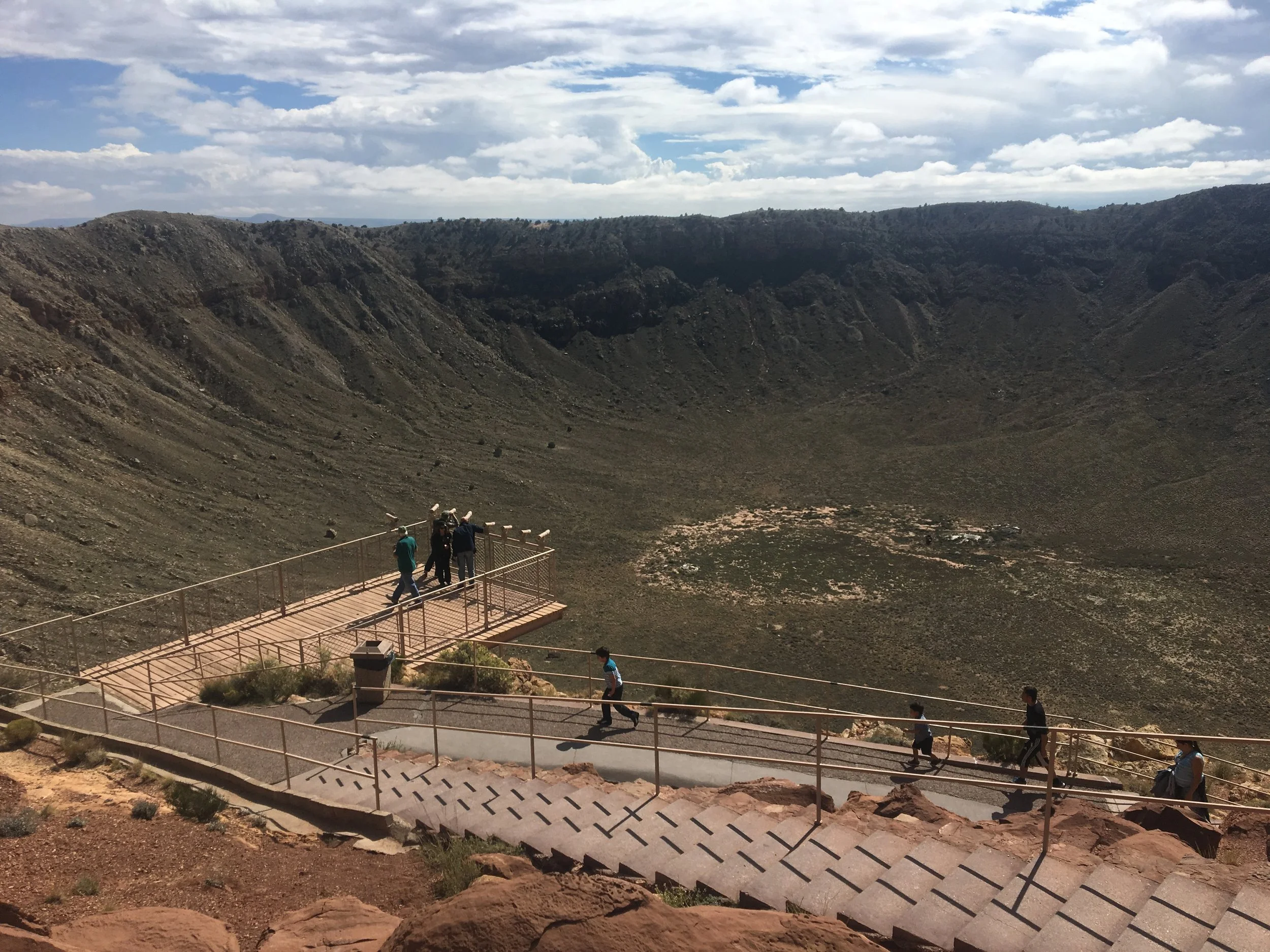
You know the crater is large, but you truly don’t get the immensity of it until you are on the ridge itself. It genuinely took my breath away when I stepped out of the visitors center and beheld the inside of the crater. It was spectacular and I’d encourage everyone to go visit this site.
I could go on, but I’m tired and am going to sleep. You know, I kind of missed sleeping in the backseat of my car. Goodnight.