Heroes and Kings: Lugalbandi in the Mountian Cave


Lugalbandi in the Mountain Cave

The first thing that strikes me is how the writer refers to "ancient days." What is ancient for ancient Sumerians? The times when gods lived on earth and when men lived for a great period of time.

This story starts out telling of Enmerkar's military campaign against the legendary king of Arrata. Yes, that would be En-sughir-ana. But, I'm only assuming so, because this story doesn't use his name explicitly. But before a confrontation is had, one of Enmerkar's commander's becomes very ill. That would be Lugalbandi. They leave him in a cave to be alone. He prays and is told in a dream to sacrifice animals, from which the Sumerian pantheon dines on his sacrifice the next day. 

I wish I had more time to write a more thorough explanation of all that is happening because it is just so very interesting. But below I've just listed a few points of particular interest. 

Firstly the priesthood is made mention of. Each one in the army on the outset of the military campaign gave each of his fellow "the sign." The sign is cryptically referred to and not much else is said of what the sign was.

A few quotes:

"His eyes--irrigation ditches because they are flooding with water." 

Referring to Lugalbandi's dream and subsequently dreams in general we get my favorite line of the story: "To the liar it talks in lies, to the truthful it speaks in truths. It can make one man happy, it can make another man sing, but it is the closed tablet basket of the gods."

Dreams are the tablet baskets of the gods. I love Sumerian literature.

Heroes and Kings: Enmerkar and En-sughir-ana


The Literature of Ancient Sumer: Heroes and Kings

This section starts out by explaining how difficult it is to determine the difference between heroes and gods, as both are usually written with the determinative signs that distinguish deities. Likewise there is trouble differentiating historical figures from gods as many historical figures deified themselves in their rule. 

Enmerkar and En-suhgir-ana

The first story we read in this section is: Enmerkar and En-suhgir-ana. My first thought, before even getting into this story is that I had originally intended, for the sake of itself, to assume that all characters were in-fact historical beings that did actually exist. And also I wanted to assume that the timeframes of these tablets had been dated accurately. I am not sure of the date when this tablet was discovered, or at least assembled from fragmentary parts, or to when scholars assert this to have been originally written, but it is safe to say that it was originally written sometime in-between 3000 BC and 1800 BC. I think most every Sumerian work falls into that time frame. 

Firstly, I want to note that this story is an account of two prominent kings of neighboring cities who engage in a three part competition to determine who is the favored sexual partner of the Goddess Innana. Now, I don't think that this is too uncommon a thing to occur between male competitors, but I can't help but find humor in that this is what the ancient Sumerians felt was pertinent to write about. The reason I chuckle so much about this is because writing was kind of a huge deal back then. First, you had to go to the river and collect mud, then you had to levigate it, then before it dried, you had to get a reed and write your story, afterwards baking it so it would harden and last the test of time! There wasn't much stream of conscious writing here, this was well thought out before hand, possibly, more likely probably the outcome of political pressure to show supremacy. 

I thankfully acknowledge an easy to understand summery of the story before it goes into the translation from the actual tablet. You can comprehend what is happening should skip the summary but sometimes it is quite difficult and often times repetitive. Several times I've already noticed that whole paragraphs are repeated, once while a king is telling a messenger what to say to the neighboring King and another when the messenger is rehearsing his message to the neighboring king. This is word for word.

There is a part of me that wants to delve deep because I want to comment on nearly every line but there is another part that just wants to get through this--because it is a lot.

"Unug,(the city ruled by Enmerker) whose fame like the rainbow reaches up to the sky, a multicoloured sheen, as the new moon standing in the heavens" is but a portion of how these kings converse to each other in texts sent by their messengers to show their eminence. 

Then a sorcerer of En-suhgir-ana in an attack on Enmerker inverts the fertility of one of Sumer's prominent cities Eres. He is caught up in a battle of magical powers with a wise woman named Sag-buru, a defender of Enmerker. The war of magical prowess takes place next to a river where they begin to cause animals to arise out of the water. However, the sorcerer's animals are all eaten up and carried away to the mountains by the animals that Sag-buru conjures from the river. The sorcerer is defeated and pleads for his life. The wise woman, Sag-buru says "Sorcerer, you do have magical powers, but where is your sense? How on earth could you think of going to do sorcery at Eres, which is the city of Nisaba, a city whose destiny was decreed by An and Enlil, the primeval city, the beloved city of Ninlil?" The sorcerer says he didn't known what he he had done, and then Sag-buru seizes his life-force, which I'm assuming means she killed him.

Enmerkar wins this dual of kings while En-suhgir-Ana is shamed. The text ends "Praise be to Nisaba!" Nisaba is the goddess of writing, of whose city was inverted in fertility by the sorcerer of En-suhgir-ana.

Note: I am still computerless. Typing on my phone.

The Literature of Ancient Sumer

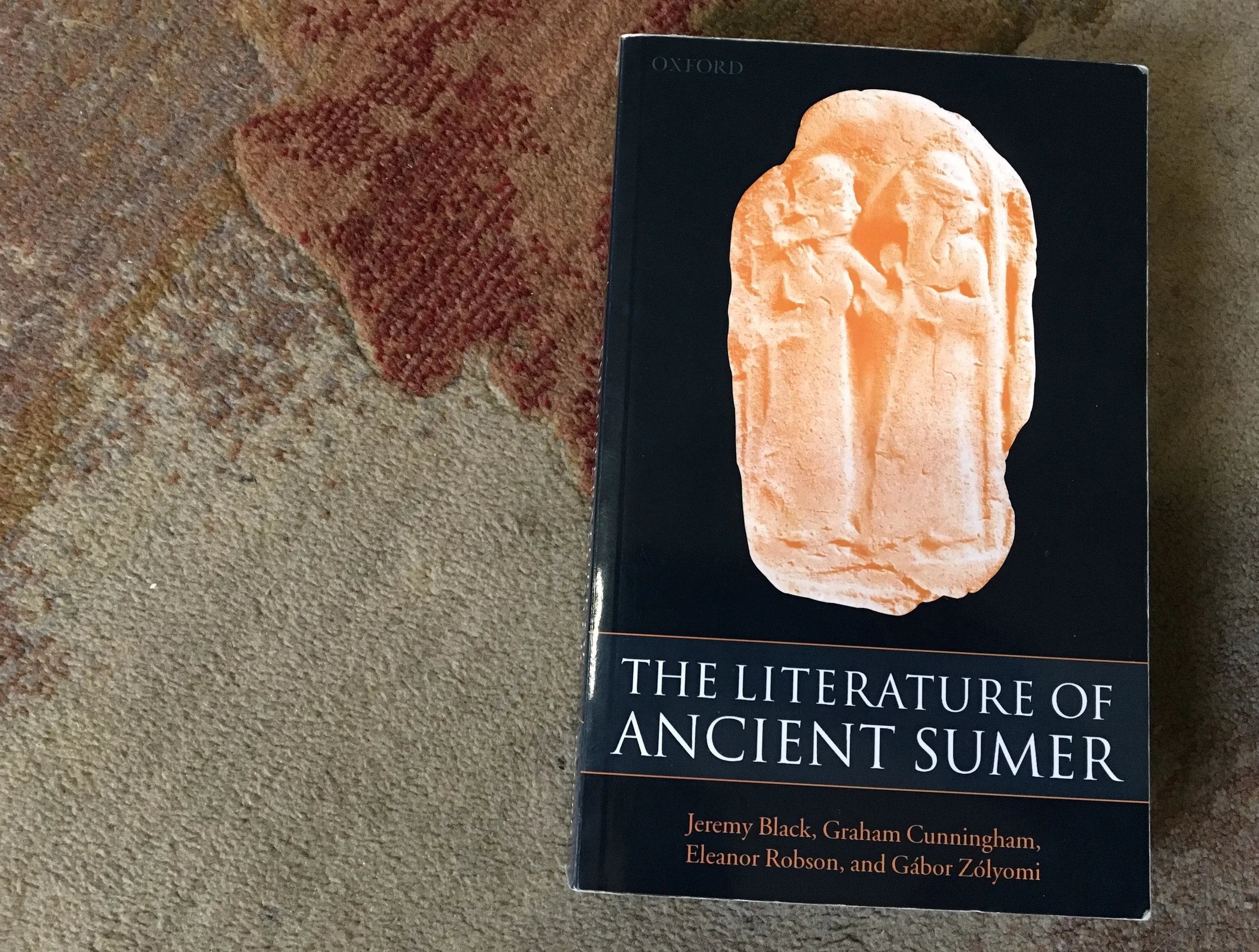
image.jpg


The Literature of Ancient Sumer compiled and translated by Jeramy Black, Graham Cunningham, Eleanor Robson, and Gábor Zólyomi is the book that officially starts my Literature of the World Project. What follows are my thoughts on the introduction to this book. It alone makes up 51 pages. Though I have briefly outlined my intentions with the project in the past, I will continue to share further details as to why I have wanted to do this as this project unfolds. I begin reading at 10:08 PM, Wednesday, November 18. Unless I feel some need to I will not typically post these entries to Facebook beyond this first post. 

Phase 1, Section 1: The Literature of Ancient Sumer

This book was published in 2004 and its compilers have stated that it contains 70 literary works from ancient Sumer. That makes up about a fifth of the known corpus. They chose these seventy works based on their evaluations of what were the most extent works and also what they deemed the most interesting. The way it is written I am under the impression that the remaining corpus in its entirety can be found at <http://etcsl.orinst.ox.ac.uk>. That would be The Electronic Text Corpus of Sumerian Literature.

Before I go any further I want to make it a point that I am simply writing my thoughts as I read. There is no other structure to this than that. 

The first thing I want to point out, aside from their explanations of what literature actually is and comparing Sumerian literature with modern day poetry, is a word that I found a few pages in that I was unfamiliar with. This word is "scansion" and this is the definition from dictionary.reference.com

noun, Prosody.

1.

the metrical analysis of verse. The usual marks for scansion are ˘ for a short or unaccented syllable, ¯ or · for a long or accented syllable, ^ for a rest, | for a foot division, and ‖ for a caesura or pause.

I will have to see this word used more often to really get a handle on how to use it properly. Also, I, because I simply cannot help myself, am going to continually note words that I am unfamiliar with throughout this project, as I have just done.

Speaking of unfamiliar words, "levigate" means to reduce (a substance) to a fine powder or smooth paste. This is what was done to river mud before making the tablets to be written on.

It was about at this point(page 13 of the 51 page introduction) that I decided to move on to the first section titled Heroes and Kings. I justified it because I had already read the introduction about a year ago and in all honesty was quite bored with it.

These works that I am about to delve into are not based in chronological order or from where they were found, but rather by theme, as you can tell by the first section title. 

Essentially the whole of the introduction went into depth on how Sumerian writing, being even four or so thousand years old is still considered literature even though it is so far removed from our modern understanding of literary works. It went into detail of how poems were in ancient Sumer and contrasted one, The Axe with a modern poem London Airport. It was all very interesting to be sure, but I am not that interested in re-reading fifty or so pages of it. 

Some days I won't be able to read much, but I do intend to post everyday to my Literature Blog, starting this very night, everyday, that is, until section 1 is finished. That would be Sumerian, Egyptian, Akkadian, and Hittite literature.

And to be sure, this isn't strictly chronologically focused. I want there to be a very loose feel to what I write. Essentially, I want to write anything that I feel like writing at the time. There is just the general rule that this follows a chronological literary path but it really is governed by my mind, a mind that has found little favor in the realms of academia, yet at the same time one that feels at ease relaxing on the sparsely populated top floor of the library at UVU as I read.

I don't intend to spend an inordinate amount of time editing or reviewing these posts. I just assume that I'll get better writing quickly as time goes by.

Well, here is to another very loosely planned project that I hope will be beneficial to me somehow in the long run. Who am I kidding? I'm so excited to be underway with this. I could care less or couldn't care less(whichever one you know is the one that I mean) about the criticism pertaining to my chosen path less traveled. Would it be lying if I told those who asked about my academic endeavors that I was studying Ancient Literature at UVU? I find myself there quite often, as I said, on the top floor of the library.  

Goodnight.

Literature of the World: Introduction

I am home. I’m doing laundry, and upon finishing this post, I am going to take a long shower. I still have two states left, Alaska and Hawaii, but I will use this intervening time to transition into and introduce another project. I want to explain in depth my literature of the world project.


Literature of the World


So, I have myriad interests. It’s frustrating sometimes. It’s frustrating because I have never been able to focus on one topic long enough to be able to gain any in depth understanding of it. I won’t elaborate much on my experience with school here. I have written about that before. Suffice it say, I think school, public or private, is a marvelous institution, vital to a thriving society. I have known amazing teachers who have gone above and beyond to help me. I have learned a lot from my experience in college, although you wouldn’t know it from a look at my transcript.

I want to make it clear here and now that I am not building up higher education to simply forsake it by ushering in a statement that “college isn’t for everybody.” That statement might be true, but I feel it is often times a scapegoat phrase for those less sincere about their education. I have future plans that involve college, plans I will not expound upon here.

That said, my current goal is to engage in an intensive personal project that I have laid out in detail, if only in my head at this moment.

I am beginning to undertake a project that involves reading literature of the world. Why literature in general, and not focus solely on, say, physics, or anthropology, or English? I am very interested in all of those topics, along with any other topic you could mention. To put it in one sentence: I undertake a literature project because it envelops all fields that are immediately concerned with humanity, by necessity, for the written word is the medium which conveys and transmits the knowledge of any professional, philosopher, theologian, scientist, and other human endeavors all together.

I am going to start with what has been understood to be the earliest forms of written language. That is, Cuneiform, Egyptian Hieroglyphics, Sanskrit and other Indian Literature, and ancient Chinese. From there I will begin Latin, Greek, and other like works, and so on.

I do this because, yes, I am interested in all of this, but, more fully I am concerned with many several conflicting world views, of which, if I, on the tail end of this project convince no one of anything other than what they already believe, will be wholly satisfied in the extent amount of information that I have acquired for myself.

If you were to ask me how old the Earth is, I would say that it is around 4.5 billion years old, which is the most currently accepted age attested to by the scientific community. However, certain Christians, hold a staunch belief that it is, indeed only many thousand years old. I simply, at this time cannot begin to believe the world is this young. That said, I want to intimately know why it is that these conflicting views exist. There are surface answers that many casually toss around, but the surface is only good for concealing grander realities that remain hidden under its guise.

The age of the Earth is only one example that I am concerned with. There are endless conflicting points of view concerned with very difficult questions, and I am, as flowing water, fundamentally compelled to find the deepest resting point of where I can quietly, in a sound environment contemplate those mysteries.

I admit that there are some problems starting with Sumerian literature and ancient Egyptian writings. I said that I would address different fields as they came into literary view on a chronological timeline. However, beginning with ancient writings forces me to address fields that have already been implemented in the discovery and interpretation processes of these works of literature, such as archaeology, linguistics, and so forth.

Addressing this, I will therefore, for the sake of the project, hold a few things to be assumed true, and suspend my critical evaluation of these fields until I ultimately get to them in their own time. This has led me to expand the nature of this project, of which I am not opposed, and its expansion will be addressed shortly. I will also juxtapose a few counter assumptions alongside each other to gain ever greater insights to what is and what might actually be true. Below I will explain my assumptions, along with the overarching process of this whole thing.

I have split this project into four tentative sections: Bronze to Iron Age Literature, Antiquity, Medieval, and pertinent writings that post-date the 15th century. I then, have allowed three phases of which I will explain here.

The first phase will simply be a casual reading of these works. I will also casually write my thoughts on each of them and note any things I deem important. Phase two will be more in-depth. I will revisit all of these works with a more critical eye, keeping note of my previous writings along with other historical content and commentaries, and then do a thorough, and truly academic write-up on each piece of literature, building along the way a body of knowledge that might lead to the demystifying of many convoluted topics.

Phase three I have left optional. It will only be implemented if I feel something of great importance needs to be brought forth to the general public. Phase three will consist of me writing a book, and or, a personal commentary on whatever subject I feel necessary.

As I said, I will assume a few things at first. For the sake of being thorough and to offer greater insights into this endeavor, I will assume through phase one that the dates and translations of the ancient literature is accurate. Upon beginning phase two, I will have a greater understanding of dating methods and languages, and translation processes to than dismiss those assumptions to make my own evaluations.

Likewise, I will also create three parallel timelines. The first timeline will indicated the academically accepted dates of all of the major people and events throughout history. The second timeline will address the more controversial dates that other people, organizations, and religions have posited as the true dates. And finally, the third timeline will be my personal timeline where I will allow my own thoughts to place people and events wherever I choose in order to visually stimulate the understanding in hopes that further insight might be gained. This final timeline will ultimately reflect my beliefs after the time and effort has been made to thoroughly investigate the people and events of most interest. 

I am also going to assume that any and all characters that I come across are based on actual beings that did indeed exist at one point. I will do this to help in understanding how it is that we determine who are historical figures as opposed to mythical figures, as opposed to biblical figures and god figures.


Phase one will really only be my thoughts on what I am reading, nothing too in depth. I will, shortly, share more information concerning my timelines and the works that I am reading.

Just to be clear, unless I feel so inclined, I won’t typically share these posts to Facebook as I did with the Travel Log. And I can’t guarantee a consistent posting time. A part of this project is to allow myself a systematic process to learn all that I want to learn without losing my progress, as I would if I were enrolled in a college course, should I be so inclined to pursue other interests. I am under no delusion that this will be an endeavor that will resolve quickly. This Literature or the World project, for all I know, could be the genesis of a lifelong pursuit of knowledge.