Chapter 1 The Whu-Thada
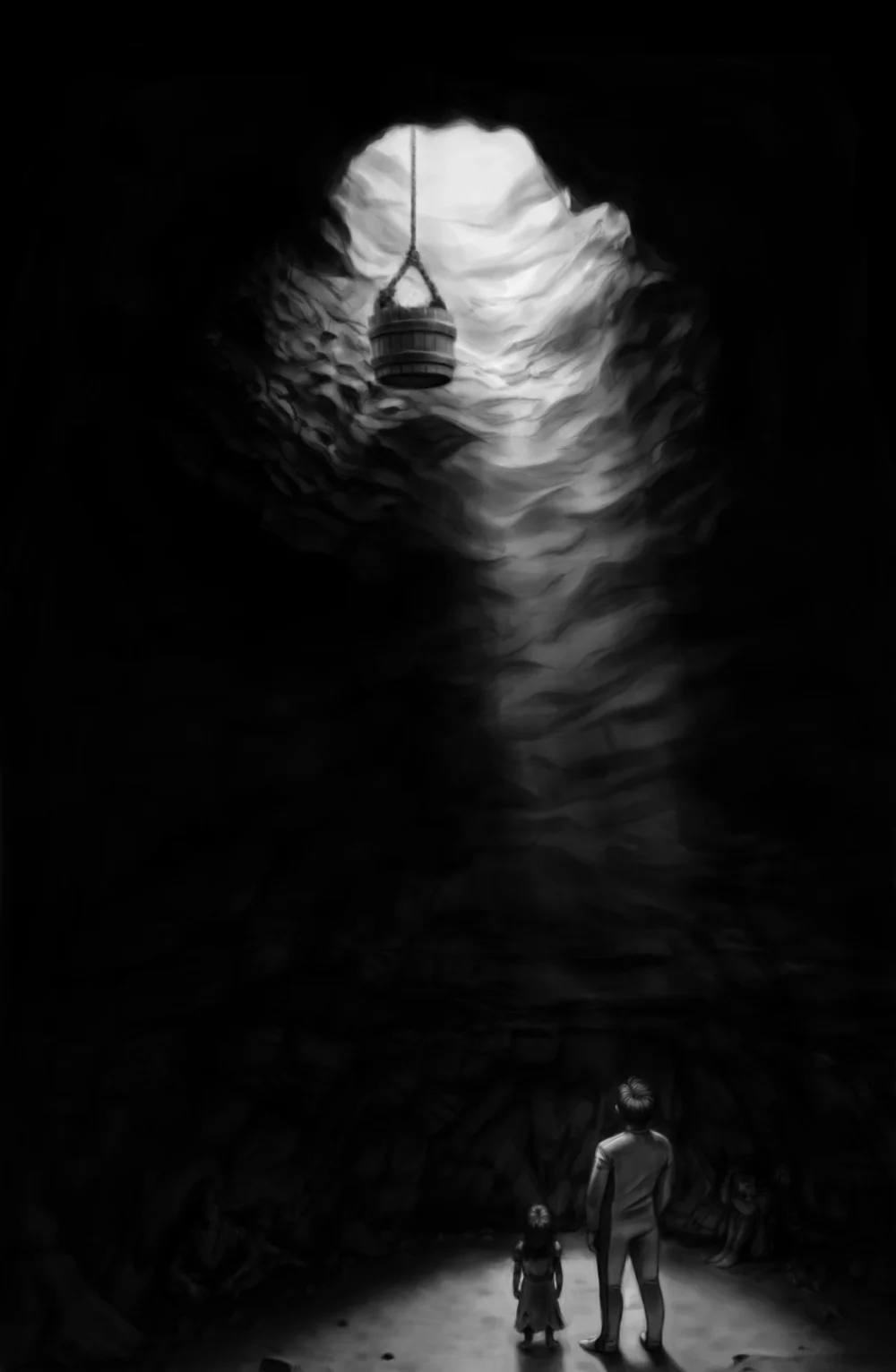
Only the daylight reflecting through a small chiseled opening two dozen Cesraminions above the inner floor faintly illuminated the interior of the basalt-black hollowed out cave-prison. The meter and a half by two meter gap perpetually taunted the low dwellers, remaining out of reach at the top of unscalable rock walls slick with dew. It was the only apparent way in or out of that abhorrent pit which stunk of the remnants of its decaying spirits, and the only likely exception to the entrance above were the wholly submerged corridors winding through the blackness of the cave from where the briskly flowing water drained in to by the veins of the mountainous underground river system. Some spunks gathered water in stagnant pools while others wound their way through the caverns like snakes through a thicket. Few—the madmen or the purely desperate alike—had drown inhaling in sporadic gulps of that oddly warm water in attempts to escape. Others merely haphazardly slipped into the downward shafts that led to the spunks, the steep and soaked sides rendering them incapable of climbing out, their arms wrenching with ever increasing weight from the futility of their claws in attempts to stay above the surface. The remains of those, then, willing to test the currents’ sweeping forces into that suffocating abysm through the channels all went silently unknown into the void, their bodies turning to the nothingness, though, only few had ever braved them. And not many of these were ever illuminated. Mostly, the caverns remained in the blackness where darkness wholly prevailed. No one ever escaped from that hellish blot, that ungodly condemnation. Yet, that was before the Whu-Thada.
A faint glow reflected off of the smooth curving interior walls and sometimes fire would appear to dance upon them as they caught those rippling flows in its reflections, but the dancing lights were only ever there during the sun’s arch across heavens dome, which, as noted by Abradm lasted for 19 hours 15 minutes on average. After that it was bear pitch black for another 19 hours, not that he told many of his calculations, for, no low-dweller around cared at all of the celestial patterns, nor for the most part would they have even be able to convey interest if they wanted to as their tongues did not match that of Abradm’s. He was an alien to their land. And this thing itself, the observation of reconciling time, was of interest to no one else in that darkness as most of the prisoners’ concerns were limited to maintaining a degree of living, albeit a deeply degraded rendition of it.
The fifty or so others who inhabited the cave at any given time wore the clothes that each had been wearing upon entering the pit. Some were worn to their ends, and others simply went naked. The filth of years in the dirty sorrows caked upon their skin, and their humanity, or that spark of intelligibleness, for many was stripped bare. Abradm though, walked the caves tall and as a stoic might, let no troubles show upon his face, albeit pensive and calculating, a strange garb wrapped around his body. Unlike the animal skins and rags draped around the others who wore clothing Abradm wore the habiliment of his people—a sleek reflective white one piece jump suite which zipped up to his neck, a grey stripe descending down from the armpit to the feet on either side—the material contrasting the night in vividness. Abradm was truly a man out of place. He remained so for the duration.
The men who dared tread near Abradm grunted and howled like animals testing, prodding, always looming, some groaning as if their tongues had been cut out. Yet, for the most part, he feared them little. Still, though, he held tight to a stone, a weapon he’d been forging, shaping and sharpening since he’d found himself in that place. He dominated the prison otherwise, with his appearance and hight. Standing nearly two heads taller than the average of them he stood out in more than one way. Nearly a solar year had passed and he had never neared becoming a beast of the void, one who learned to skulk in the caves finding the darkness more appealing than light. Some in there ventured beyond the degradation of humiliation and embodied the darkness over time evolving to be less than men, yet barely more than beasts, for they had once been men—of a kind. Those who made their stay in those deathly halls slowly became dark souls. They were dirty, vile creatures, only a few of whom had been that way before entering as was their punishment deemed appropriate, but many became that way over time, the mountain’s darkness compelling the largely innocent to baseness and taking them for its own. There was one man, nameless for years who took on that mantle of the shadow of terror, who's eyes were long devoid of life, love, hope and humanity. He hated many, but above all he hated the strange Abradm and on occasion went out of his way to degrade him. Testing his limits he had tried to kill him more than once. But Abradm remained a step ahead.
The premise of the prison was based on the lores of the ancients. There was in time unwritten, or so it goes, an ancient King, venerable and headstrong who had been humbled by the mountains fiery wrath. He, stiff jawed and on bowed knee struck a covenant with the three gods who presided over his dominion. Between that trinity and the proud King of Cesrimine, whose name had been long forgotten, who dwelt under its peaks offered the mountain sacrifices of living men, while it, standing tall and ominous, observed for stades around with its unique triple peaked crown appearance would make, henceforth, the mortal Kings under its shadows prosperous in that its valleys sprang with living water evermore. Living men in exchange for rarified healing springs instead of rolling infernos of which had in times even further unknown decimated the plains, destroyed the crops and with billowing vapors wreaked havoc upon lands even ambits away. And so it was the tradition of the valleys’ kings in succession from one to the next from time immemorable remained to send their kingdoms petty thieves and their beggars to that pit merely to appease those swayable mountain gods, whose names remained only in the corrupted tongues who spoke the names of the three peaks which overlooked the valley, Gorbrana, Cu-Chellis, and Xylics, yet the tradition remained. The Kings of the valley Cesrimine decreed and demanded tributes from the nations of the corners of the world so as to never again summon the wrath of Cu-Chellis, the middle peak and supreme deity of the land. But over the years the once lighted pits where honored prisoners dwelt and ate in holy communion, presided o’er by established priests, became little more than a cesspool of disease and putrid foods whose torches and holy writs had burned out long ago. The tradition now, was nothing more than cold condemnation to a life of darkness and suffering inside the bellies of forgotten gods.
The bellies of men were another story. The meals of the once honored prisoners had been, at a time, as sweet as the best creams Le’ernedi, the neighboring country, could offer, and the beer and hops of the fields of Reysons proud warrior family to the east were sent on guarded caravans by Royal Uhlans. Bread, and cakes, and olives and wines of the most exquisite orchards, wineries, and bakeshops from all corners of the world were sent to the halls of Cesrimine for meat to the prisoners, all in hopes to appease Cu-Chellis. But now, after the once noble reigns of the ancients, the prisoners’ sustenance consisted of nothing more than slop which was given them from the unseen keepers of the cave entrance while the Royals of Cesramine took the feasts for themselves in sacrilegious gluttony. The guards at the outpost which stood overtop the entrance lowered the remaining juices, moldy bread, decaying swine carcasses, strips of leather, and rotting fruit that remained into the pit in a large wooden bucket which dangled by an ever fraying rope through and around an awkwardly constructed pully system. It creaked and strained, and echoed throughout its caverns. This was also the only way the poor newcomers entered. They were slowly lowered in, their hands tied, kneeling awkwardly in the slime that which was meant for eating. The bucket, just barely large enough to fit uncomfortably an average sized Ceserminion in swung back and forth as the inductees panicked and flailed to one edge and then another. More than one man wept in anguish writhing on the sides of the wooden planks digging his nails into its bark as the darkened beasts of the abyss rallied below for the food drop. No one, no poor body entering that horrific place could have ever been certain of what it was that was going to be eaten—the slop or themselves—the grunts and commotions of the pits’ beasts stirring and circling below as the groans and squeaks of the system strained against gravity while light itself seemed to condemn the descenders as their pupils widened rapidly in dreaded acknowledgment of it’s gradual secession.
Once they managed to survive the wild and barbaric gropings through chunky slop at the cave floor and free themselves from the bounds around their wrists they soon came to understand how the beasts of the caverns worked. After the initial shock was through, they came to know that when the low dwellers weren’t scuffling over their daily allotment and subsequently terrifying the newcomers, they, by natural order coalesced, as water does to the low spots, into rudimentary gangs within the caverns. Each one of the gangs obtaining varying degrees of loyalties from their inductees, and varying degrees of structure as minor government bodies began to emerge, and a crude social order appeared, whereas it was apparent that the tall oddity of Abradm remained, more or less to himself, contemplating in his loneliness things the others in the godforsaken pit couldn’t begin to fathom. He found solace in the wonderful rectangular window that shone the light of the sun during the day and the pinpricks of starlight on clear evenings during the night. The arcs of the sun, and the heavens rotation were very pertinent to him in ways the others couldn't begin understand.
Something to get used to, to be certain, especially for Abradm, was the unavoidable depths of the darkness itself. In its deepness, however, he, being naturally inquisitive, and with great difficulty had mapped out nearly the entirety of the cave with the help of a few natural aids. From its farthest ends—the arms that reached into the rocks—he measured the length of the longest arms of the pit to be nearly nine hundred meters in length. With the use of a makeshift rope he had woven together from the strips of leather and hair from animal carcasses he pulled from the food drop, he even scaled the deepest arms descending dreadfully downward in twists and turns in a steep and dangerous climb to their bottom where pools of stagnant water gathered—the walls, sleek and black were filled with cracks and small openings from where drizzled constant streams into them. But to those water pools which lay below the rushing subterranean rivers on the main level remained only the length of the longest span of the cavern’s arms put together. Some caverns went on hundreds of yards alone winding up and down, in and out, but they all ended eventually. Every one leading to a dead end with nothing but more rock and darkness, that is with the exception of the arms leading into the doom of the water. Beyond those surfaces were lengths he simply couldn’t measure without tremendous risk, that of slipping and drowning helplessly along the slick rocks which descended into the pools.
The whole of the complex looked to be, he thought, the remains of a long abandoned mine of some sort that had collapsed during a period of extensive quacking, although he only surmised this based on his schooling which was far removed from his current predicament, yet all those things he learned in bright arrays of information transmissions remained in his memory at call. Otherwise he had no experience in such manual belaborment, nor had he ever needed to or been obliged to exist in such dirty and dark atmospheres, the weight of the world in that place seemed even heavier than what he was used to. Even during those daylight hours, there were areas where no light whatsoever reflected in to, the areas that the darkness had swallowed without compassion. It was frightening beyond measure to begin to contemplate just how the stillness of the place reached into the deep of human understanding when the absence of light prevailed with seeming superlative authority. The barriers between the exterior world and the inner began to dissolve away for the condemned and there began to be no clear distinction between what was outside of them and what was inside, especially during the hadias.
The extended absence of visual stimulus during the night gave rise to an unusual display many of the weary souled prisoners welcomed. And if one could learn to appreciate the darkness for what it was, one could see that cascading colors would indeed flurry in and out of existence. Some thought they were light goddesses, others thought they were fairies, while some cared nothing for them as they were of no significance to their livelihood, so dead were the passions of the darkened souls that neither intrigue of the unknown or wonders of the mind penetrated their dogged demeanors. Those who cared, however, called them hadias, that is, starry spirits or starry worlds, yet Abradm knew that they were the product of only the mind and that the true starry worlds were beheld within that little rectangular opening which remained frustratingly ever out of reach. Some found innocent joy in the hadias regardless, and even some grizzled old men laughed as children while others simply went mad. Cackling could be heard in the halls of the deepness at times and other horrific noises where two or more dwellers found themselves upon an unsuspecting newcomer.
“Hadias! Haidas!” And then howls which echoed throughout the caverns.
Light goddesses, fairies. The deep struck the body, and the insane wore on the nerves within its blackness. Sanity was a precious commodity in that place. Yet it remained so for only those who kept it.
Sometimes the lights, blue and orange, red and pink and white caused some to weep, as their understanding began to blur between what was there and what wasn’t, living souls entertaining to the extents of their consciences the imaginings of their beleaguered hearts. The hadias would transform in the minds eye in swirling motions of pristine light into the long lost lovers that roamed the corridors of their minds, haunting them. They reminded, even the most loathsome of them of their losses, so great they were. Many lost family and dear friends upon their arrivals. But for all, the loss of the land above that place where the range of freedom was prevalent even under the suppressive rule of tyrants, and where the beauty could be beheld daily, where the sun shone on all and trees and flowers decorating in wondrous displays of nature the countrysides. It was the places where rivers sparkled with clear and fresh tasourty that remained the most difficult burdens for those who had lost their lives to the stomach of Cu-CHellis. And Abradm, being silent, day in and day out, had lost more than the rest, yet he never abandoned his hope into that void, albeit a seeming miracle just before he might have. Through the images conjured up, the weights strung upon his heart anchored his head cinching it upward toward that real light which warmed his skin and powered his thoughts—the sun and the stars, which were real. But hardly any needed care to whether what their products derived, whether they were real or imaginary, for to find any sort of solace in the absence of joy whatsoever aided the lonely heart at whatever expense it took upon the brain. These shows of human depths, the hadias were the well acted out plays that the wretched scum and the unfortunate were audiences to. These were they who’d found their lots at odds with the King’s rulings, although it had been rumored, even in those dank confines that there had been endowed recently a new king, one who was The Usurper of the Crown of EL-Torrans, Cesramine, and one who claimed to be of divine origin as he exercised unimaginable powers before the people—the embodiment of Cu-Chelllis, no less, he claimed to be. Which, for those who hadn’t gone mad all together elicited rare, but powerful hope that this new King was, in fact, the primary mythical deity of the mountain come to redeem those who'd been condemned to its deathly caverns.
The offenders of the Crown were indeed, abandoned to the dark and forgotten about as an unpleasant memory is hastened to the back of the mind. And they were forgotten about. Even the light duty of those charged to keep the prison, the unseen keepers, went wholly unaware of the conditions below where the men were left to decay in complete darkness for those fifteen hours every day. Although, truly an oddity, more so than the rest of the strangeness surrounding Abradm, if ever so faintly, hadias’ aside emitted his own light at times which low dwellers had noticed immediately, estranging himself even more so from the others. This gift of heaven is what allowed his descents into the darkness. It shown from his eyes, a light, nearly blue in hue. A whu-thada, they whispered with guttural groans and slashing glances back and forth in the dim trickling light of day. After nearly a planet-year of the hell listening to their nonsensical mumblings echoing throughout the darkness, there he began to assemble some coherent structure to their sparse words, rudimentary it was. Even though, for the most part, they shunned him, they called him whu-thada. He came to know that it meant “demon.” He shone when no one else did. He was the whu-thada of the pit, the embodiment of the hadias. Yet, even at that, he managed to find one friend among the lot, a young and lively Cesraminian girl, who had recently been condemned, and who made no attempt to reassure Abradm of the new God-King’s intentions to abolish the acts of feeding the mountain his citizens, because despite the frenzied ruminations of the poor lot, he had none.
Abradm and Trearishmeen, had been looking out for each otherfor five and two thirds months, as reckoned by the Whu-Thada’s understanding of the world’s revolutions before the event occurred which liberated himself from the cave. Never forgetting why he became the whu-thada, and speaking almost nothing to each other the two worked together cooperating on behalf of each-others wellbeing. Abradm protected her in that darkness while Trearshimeen explored the areas of the caverns which he couldn’t and they soon gained a bond one with another. He helped her to learn of the toughness of leather and animal hair in making rope, the reflections of light and forms of communicating with it, and many other things which largely went unknown to the entirety of the Cesriminion Kingdom and nearly all else who existed in the sphere of its domain. They spent hours in the depths of the darkness sitting on the edge of the cliffs which led to the spunks talking and gesturing to one another, listening to the roar of the underground rivers, light reflecting off of the walls emanating from Abradm’s eyes.
“Do you see,” he carefully pointed to her own large hazel eyes and then shining his own steel blue eyes toward the rippling pool of water below, which in this area had a fall spewing into it, “that, the tesourty,” he waved his hand up and down mimicking the roll of water, “remains level—ashtata.”
She looked intensely at the surface of the splashing pool, “remains ashtata,” she repeated.
“Asida, mochktata,” she spoke softly, and then confirmed with exuberance in a deep Cesriminion accent, “Yes.”
“Do,” he then pointed at her chest, and then pinched all of his fingers together reaching to his temple and then opened up his palm extending all of his fingers at once, “galeedea?”
She looked at the waterfall, then stared for a moment at the ashtata tesourty, as his gaze followed hers.
“Sida,” she spoke as her thoughts ran wild. She smiled.
Under the spell of near complete silence they began to speak a mutual language. They plotted, they learned from each other. And slowly they began to communicate more fluently as their own languages merged. Not that she ever much was, but Trearshimeen became afraid not at all of Abradm’s shinning eyes, overshadowing hight, and strange garb. She called him, “adee-ohre.” That is, wonderful spirit.
“Un-calimun, re fathan,” Trearshimeen spoke softly and intensely with a little quiver in her voice. It was nearly always there. More often than not she held tight to Abradm’s arm as they spoke.
“Yes, the…” Abradm contemplated, “the… farmlands. Re fathan.” He repeated.
Trearishmeen had come from the farm-towns near the borders of Garpen and the capital city Cesramine. Abradm listened to the girl’s often trembling and quiet voice and picked out tones, words in which were accompanied by gestures, and proper nouns. Quite quickly he gained a primitive understand of how she had lost her father recently in a terrible war toward the east. He noted that often her hands clasped together in front of her face while she kissed her thumbs and looked upward, almost, Abradm had noted, as if she were partaking in an ancient custom which he knew as prayer. But she didn’t pray to Cu-Chellis, that monstrous beast in whose stomach they resided, or Xylics, or Gorbrana, his left and right hands. She prayed to one whom her father prayed to who was the God of the Sun, Ocernes—the same god that Abradm spent hours contemplating, but not in prayer, rather, in his intense empirical calculations, for it was Ocernes that wandered across the sky daily and of which he timed and tracked. The war, however, that she spoke of was one fought in the name of Ocernes, and over fertile lands. This god had been solicited by more than one General on both sides of the dispute to inspire stoutheartedness and to encourage unity among chaos during the fierce and violent hysterics of war. Of course these were the issues the kingdom of Cesrimine was facing. What other reason for there to be bloodshed amongst kings should there be? Fertile lands and strategic strongholds remained the most important things among the world and Kings had commanded their last men into imminent doom to keep them. She explained further that when her father hadn’t returned from the battlefield but instead was greeted by the war-lord who ruled over their sanction, she ran away from her brother’s home. Being without a mother from a young age she found herself begging in the streets of El-Torrens as a dirty little beggar child, from where the Usurper had ruled to send her to the caves as had his usurped King and his predecessors done for generations with beggars who stirred troubles. Yet, the caves under the three gods had never seen the likes of a little girl. It was unprecedented and not what Cu-chellis had ever demanded. The new God King appeared to be little different from the mere mortals who had all attempted to appease the gods of the mountains for generations prior, yet, with all his might and showy prowess, the Usurper remained mostly ignorant of the tradition, only understanding what he could make out in preliminary attempts to know the tongue of his wary guards whom he had persuaded to his side as they dwindled in the long absence of their King who remained in far away lands, crusading. He too spoke an alien language.
The Usurper sat on his throne while the Whu-thada contemplated in the void. What was to be done? There was so much at stake, yet Abradm remained unable to do nearly a thing for quite some time other than map, live, eat disgusting food of which he had been slowly weening himself off of ever since he had met Trearshimeen, and look at the stars with her. She asked in still moments of exalted reflections where it was that he came from. And he almost always was struck with an immense inability to explain. Yet sometimes even in his longing, he showed them to her, and not just in his dreams, nor in his hallucinations, nor in his hadias. He showed her, at times, where they slept in celestial limbo.
Sometimes at night when the clouds were gone and the sky was clear, he sat with Trearshimeen and watched the small scenes of the sky in their perfect stillness twinkling bright, the stars, shinning brighter every night it seemed. On occasion and more than the rest of his family, he spoke with Trearshimeen of his brother, whom he had played games with, moving pieces of different sizes on a board of real Oak, not synthesized materials, but old and splintered wood, and sometimes in rare instances he spoke of his wife whom his loved spanned the stars, using words such as “beautiful,” “breathtaking,” and “golden hair,” and “joy” in describing her, all while Trearshimeen innocently smiled largely unaware of what Abradm was actually saying. The two gazed into the stars filled with wonder and endless space night after night, Trearshiumeen holding tight to Abradm. And every once and awhile they would catch a glimpse of a wandering star. One that was visually perceived to move across the sky in a slow arch. It was different than the occasional shooting streaks which were “the falling angels” as Trearshimeen had spoken of. And he always gasped then and his mind raced as he craned his neck to see the little light move across the rectangle slowly and before it disappeared. And this happened every time. Speaking in a garbled Trearshimeens tongue, he hesitantly spoke, “family—da ozum.”
Trearshimeen’s eyes widened and she spoke softly in wonder. “Do’ar, eb enzahim Osernos?”
Abradm looked pensively at her ghostly and malnourished face, a tear darting down his dirty cheek —her large hazel eyes beamed and seemed to parallel the twinkling of stars in heaven catching the faint light—a brightness so vivid surrounded by impenetrable darkness, and lacking the words to explain in detail, he merely spoke the word “Heaven” as he pointed to that wandering star, and then spoke nothing more of it.
“He-aven,” Trearshimeen repeated softly with a glow. The clouds rolled in then and blocked their view.
One day as Abradm was fending off the urge to eat, he seemed more pensive and tense than usual. He called to Trearshimeen and then after a moment realized that she wouldn’t answer. There would be no soft echo of a child’s voice. He had done this a few times over the last month that she had gone. He, in shaky weakness began to grasp his chest. His skeleton like body arching to the ground as an old man fighting to stay upright might. An abominable despair gathering in his chest began to tear at his strong facade. Knowing full well that she was now no longer present he scoured the caverns for her in panicked loss, and he, in more of a rage than had ever escaped his demeanor even confronted the man who would have killed them. Yet, it proved fruitless. He had nothing to do with her, and Abradm knew it. She was gone from the place. He raced to the edge of a sleek cliff submerged in the view of darkness and of which slid downward to the warm waters edge at the end of the halls of which only he could see hoping she would be there. He did this often, but she never appeared. Discovering his rope wrapped tightly around a near boulder atop the slope while dangled over the edge, he knew that she had tested the waters, feeling her way to its edge and grasping the rope which they had strung down the sides. She was nowhere to be seen. Yet, he knew all of this. His losses were beginning to break away at his chiseled stoicism and his emotions were tearing away at his rational. Too long he’d been in there and too much he had lost. His brother, his wife, his freedom, and now Trearshimeen from an idea he wished he had never proposed. He was abandoned to the pit. She was gone. And he wept in bitter anguish for the first time upon entering that place. Once again he was alone and found it near impossible to reconcile the truth of it. He tore at his thinning brown hair in guilt clenching tightly his fists and slammed the walls of caverns until his fist bled. Anguish welled up in him just as the water created the spunks in the darkness, devoid of life and light, no hazel eyed innocence to ease the ache.
Not only had he began to embody the pit, as many others had, the others who shunned the whu-thada were slowly becoming more aggressive toward him. They too began to utilize the bones and other products that came from the slop—they made weapons, after all the beasts had learned something from the Whu-Thada. Resourcefulness.
One day Abradm, his face stonewalled, his eyes sunken in, laying on his back stared at the opening and noticed the common commotion around him as the prisoners waited for the food drop. There was the familiar sounds, clanking and echoing throughout the caverns, and then motion atop the walls. He held his breath with little movement. The rush of dwellers ensued as the bucket slowly lowered, the noises of its system groaning and creaking. Abradm waited. He held his breath still. It hit the ground and every one, like rabid animals rushed in to get something of the slop. Two minutes and ten seconds he noted as he gasped for air, a clock running through his mind he could perceive effortlessly. He breathed rhythmically for a moment, something he and Trearshimeen had practiced in meditations. She, being young and naturally gifted, well accustomed to the world always held her breath longer than Abradm by minutes. Still, he waiting as the others ravenously feasted, tearing at others and pushing for dominance around the edge of the bucket. He gripped his refined stone with sharpened edge nervously even though he appeared unmovable in his grim demeanor. Even the light from his eyes was fading. Then as the others slowly dispersed from the bucket back into their darknesses he slowly stood and wandered to its edge and in total indifference peered in to see what had been left to eat. It was the typical slop. He reached in and stirred the mush with his finger, pulled out a piece of swine flesh which he tore from its carcass and ate it. As he bit down on the flesh energy suddenly left his body and he fell to the ground knocking over the bucket of remaining juices as he did. Nauseous, he vomited as he fell and uttered a few horrendous cries to the gods of the abyss. The beasts, then, suddenly again began to circle ‘round. The whu-thada was compromised, and the man he had hitherto fought with for his time in the abyss returned into the light and darkened its sheen while the presence of the rallying creatures thickened the air. Abradm rolled onto his back in utter despair, his vision blurring, and while wiping away the spittle from his lips and gnarled black beard in a moment he decided to welcome his death. His glory, his love, his purpose and hope was gone irreachable. Fate had taken him from the engines of Heaven into the furnace of hell. But then, as the warmth of loved ones leaves even death without a sting his upward gaze fell upon an odd light that he had never before seen shinning through the rectangle and reflecting off of the inner wall opposite to it. It blinked, stayed for a moment, and then flashed again. The blinks repeated and repeated and continued without stopping. Abradm’s brow furrowed, his lips quivered and he gasped, and in an instant strength flooded back into his limbs. His eyes darted around the cave and the shadows encroaching in upon him seemed to fly across the walls rampantly. Even in this moment of terror there was a part of him that was overcome with endless pity for the lowest of them whom were even at that moment in the attitude of death-seeking. In one decision of self preservation and sacrifice unknown to any of the readers of this story he understood what he was to do. The light reflecting off of the walls and blinking in regular patterns seemed to lift his spirit upward toward that light, yet his body remained attached! He stood, gripped his stone and slashed at the rope which was attached to the bucket, and then the attack commenced. Abradm, with fiercer emotion than he’d ever displayed in his life stripped off his jumpsuit, fended off the demonic creatures of the void one after another, detached the bucket from it’s tether and with a display of unprecedented mental and physical exertion made his escape into the black hallways of the abyss.
Chapter 2 Requiem
Two worn and sleepless men sat facing each other at either end of an uninspired metallic table, somber in the attitude of contemplation and profound stupor as they stared at an ancient checkered board lying in front of them. Surveying the wooden square and analyzing their moves, their mistakes, it was apparent to one another that their strategies were both compromised. Fatigue was setting in and external stressors were mounting exponentially. There was little more that could be done, though. So, they played.
Their faces were dirty, smudged with engine grease, and their jumpsuits were ragged and frayed. The atmosphere of the room was dim and ghostlike, and a red wall-light lit up the metallic foyer every few moments glinting off of each table and their eyes. An eery, long drawn melodic sound echoed faintly throughout the hauntingly now bootless gallery of their bubble. It seemed to be the whirling sounds of the atomic structures in that far distant forbidden space, each atom crooning in the subtle embrace of its omnipresent author. The two easily could have felt that this surreal and angelic opera remained only in their minds. Several odd glances between them had been shared ever since it started, confirming along with the help of their central computer that it was, indeed, an exterior phenomena radiating from some unknown source, albeit faint, almost not there, just under a whisper dispersed upon the air.
Hopi sat on his stool leaned back against the wall on his side tugging on his unkempt thick black beard while he contemplated how much thought he needed to put into his next move. Then after a moment delay he reached out over the table—a fresh pink scar running along the edge of his hand from his pinky finger to beyond his wrist was apparent—and he moved a little painted black wooden piece to a square, b5, with a heavy sigh. It was a figure in the form of an ancient kneeling warrior wielding a sword in one hand and a crucifix in the other.
“Your move.” He said in a deep, gruff and detached voice.
Abradm stared intently at the board almost mirroring Hopi’s posture. Thoughts struggled to connect as he worried about his strategy and how painful it was to exhale. With great pain every movement rippled through his faculties and into every muscle and bone in his body. It even seemed to hurt merely sitting still in the stiff and cold atmosphere. He sniffled. His breath was nearly seen and both of their faces were pale underneath circles of darkness.
He took a raspy breath, “You blame me for all that’s happened, Hopi.” Abradm more or less stated matter of factly.
“You know very well my thoughts on the matter.”
“Yes, but we have not spoken of them.”
“We need not to. It is to only waste breath.” Hopi almost whispered.
“Then you needn’t have informed me that it was my turn. I knew it was. You want to speak.” Abradm stated.
He clenched his teeth tight and a grimace came over his face as he glanced at Hopi. Hopi sighed irritated. With exhausted eyes Abradm then looked down on the board filled with characters facing off against each other, each one holding a unique shape, and each one hand carved from real oak infused by some unseen edict with unique traits to maneuver how they would. Abradm shivered and thought for a moment of the ramifications each of his moves had in the larger picture—gazing downward on his faithful subjects—all ready to die at his command—perhaps as a weary god might have looked down on his valiantly struggling soldiers in the midst of some horrific war.
“There is something to be said about speaking,” he let out a somewhat defeated joke as he wrapped a synthesized jacket thick round his chest, a faint quiver rumbled in his voice while below their feet simultaneously a tremor reverberated throughout—some of their pieces seemed to move by themselves as the table vibrated the checkered ground of their own world. Hopi didn’t care for the joke, but they both immediately glanced at each other with worry in their eyes, yet it was nothing new. In fact, the tremors were becoming more common. Abradm fidgeted while Hopi stared grimly into his brother’s eyes for a moment, his forehead glistening in a cold sweat and his brow furrowed.
Ignoring the tremors Hopi spoke suddenly with rapid words in his deep resonate voice, “Shall I move for you, brother. You may give me no other choice.”
Abradm didn’t look up. But No he thought clearly, and Hopi only stared annoyed as if he had heard his brother’s thoughts. He thought for a moment longer, dismayed he then slowly moved a magnificently rearing destrier equipped with its armored Knight onto square e2.
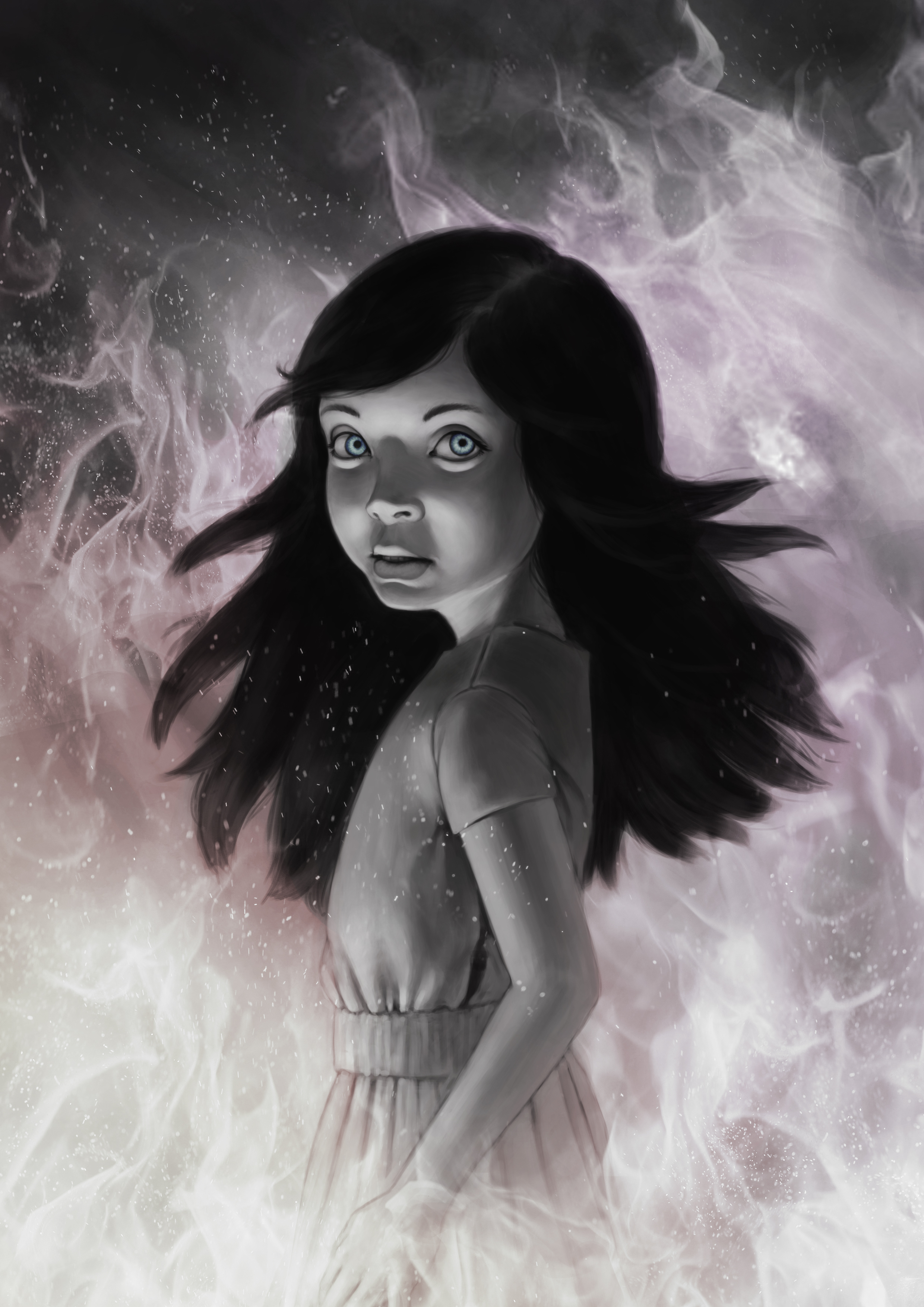
Suddenly and before Hopi could make his anticipated move, Abradm gasped and the game was interrupted. There, hopelessly standing in the room across from where they were sitting was Trearshimeen clad in the same torn and dirty dress she had worn in the abyss. She stood there confused and looking around somewhat frantically and disconcerted.
“Tre!” Abradm said in wide eyed astonishment. Tre is what he had begun to call her.
Quickly he mumbled a few uncertain phrases under his breath and ignoring his aching body stood racing over to her clumsily knocking the stool he had been sitting on to the floor and clanking the table knocking a few of those pieces over while others tipped about. Hopi, with no regard to the strange new girl fixed his eyes on one significant piece of his opponent that in a moment tipped precariously onto the edge of its base which was carved into the fashion of an immaculate royal throne occupied by an old grey bearded king. It wore a cumbersome crown and a robe draped over his royalty’s body. It sat back down upright properly onto its square, and Hopi grunted.
“Adeorhe.” Trearshimeen smiled with tender relief as Abradm approached her.
“What are you doing, brother?” Hopi suddenly scolded, still staring at the board contemplating his next move.
Trearshimeen paid no mind to Hopi’s condescending voice and she started to walk toward a dimly lit corridor that exited the room as if being pulled by some unseen etherial force. Abradm paid no mind to Hopi’s irritating tone and followed Trearshimeen, as if being pulled by some etherial force only glancing back at his brother once cautiously as the two made their exit, leaving Hopi to curse under his breath to the now unsecured game board.
Trearshimeen, in a serenely innocent manner only spoke with Abradm in short sentences in-between long pauses while she gently ran her hand over the sleek walls of every corridor she passed through. She methodically strolled through every one light as a ballerina striding upon the rays of sun, yet, there was simultaneously an untouchable darkness in her eyes, impenetrable that through her veins did run. The rising darkness befitted no one, let alone a little girl. The clouds were billowing in.
She wound her way through halls filled with pipes and coils and panels with buttons, and Abradm followed and answered the many questions she started to ask—the occasional tremor reverberated throughout.
“Where are we, Abradm?”
This must be a dream he thought to himself. But he knew where he was, at least, in this dream. Quickly and subtly, before answering the girl, almost as if placing this vivid vision of sorts on pause, with an air of awareness which he, along with those of his kind had been obliged to become acquainted with, he out of trained repetition reached his hand over the top of his own head and slowly grasped the empty space above his dome out of view of his eyes while he looked forward. Before his fingers could pinch together through the empty air a small object suddenly appeared before his hand. He grasped it, bringing it into view and thumbed a keyhole in its side. He clenched his other fist at his left side and in a moment which seemed like magic a small metallic key appeared in it. He then put the key into the key hole and with a sensation of supernal wonder he opened the object. He peered into the tiny aperture which in its smallness miraculously contained a whole universe swirling about with red and purple and blue vivid lights among other things only known to his deepest subconscious self. His visible breath which drifted near to the opening of this portal evaporated as it approached the universe—one reels about in contemplation of what a breath of a god might appear to be to the searchers of some nascent star gazing civilization—and finally with a longing relief he closed the object up again.
After a moment he breathed deeply, composed himself, and, satisfied with what he had seen, the box along with the key vanished into the thin air. His attention, then, quickly turned back to Trearshimeen, whom he was stunned to see gazing at him in a pensive and analyzing manner.
“What was that?” She asked, to Abradm’s utter surprise.
This was no normal dream.
“Tre.” Abradm diverted her second question with an air of unease and returned to her first. “This is Heaven.” he said as he looked about at the innards of a dreary and spiritless vessel.
A unique capacity to attain the vivid presence of mind within a dream heralded through Abradm’s thoughts, and even in this foggy locus, he reached out to note that there was no straining to communicate even in the least as he recalled that He and Trearshimeen had in the dark and hellish cave-prison, and the things that she said were understood in his very tongue with no trouble whatsoever. With a higher condition of awareness than most, and with a strain of curiosity that encompassed he, along with the rest of his kind, he strained within that confined avenue of a dream to focus in on even the subtle motions of the little lips of Trearshimeen as she spoke, to study this oddity, curtailing the vague representations dreams attempt to get away with. He resolved to an awareness that would never have been, and indeed, the motions of her lips matched that of his native tongue—English. His mind raced faster than it had in quite some time. This was, most certainly, a dream of dreams waltzing in enigmatic serenity with his consciousness.
Suddenly Trearshimeen’s hand swept over a new material as they continued on. It was glass or some compound of it. It was cold and it rumbled. The tremors were getting worse, yet, Trearshimeen’s eyes were caught up in the strange fast moving wisps of grey etherial strings zipping through a black void in front of her eyes as she held a hand to its surface.
“That is outside.” Abradm said.
“I don’t understand.”
“I don’t suppose you do.” He whispered.
And then, with a whooshing sound a door to their left slid open and the two of them walked through it. Trearshimeen looked around silently for a moment before her eyebrows began to curve upward as she tried to hold back her welling emotions.
“This is Heaven?” Unsure she sputtered quietly as her heavy eyes gazed into the abysmal room.
They had entered the Parkway. It was darker than the rest of the vessel, and sadly, it reeked of death, even more so than the abyss of where they ate rotting flesh together. Only a faint red light blinked silently reflecting off of thousands of wilting and decaying plants. The music almost unheard at this point suddenly spiked with an intense burst of emotion and began to crescendo. Whole trees that once had stretched hundreds of feet into the vast glass domed structure had fallen over entirely, their roots left bare and their leaves, brown and crunchy were strewn throughout. Over the brick pathways that were once lit by the power of the stars in nearby systems lay wrinkled and shriveled vines while tomatoes rotted on the floors and carrots and lettuce were turning black in planter boxes. The nostalgic nods to a distant world could be seen in the antiquated trash bins and stained wooden benches lining the winding brick walkways—all mementos to a distance realm.
There was a foul scent that permeated the air, and a doom fell over them both as they beheld the work of death amongst the long absent miracle of life. Abradm looked around disheartened, his eyes darting from one end of the massive room to the other while they filled up with tears. His breaths became shallow and his emotions were clear and distinct, something Trearshimeen had never seen of him when they were in the abysm. There was no detachment. His stoicism was nowhere to be seen and he felt all too bluntly the horrors of this wretched predicament rise up in his chest once more, the very predicaments that had taught him to engage in the search for peace in the controlled motions of meditation. This was Abradms home—and it was in its final repose, and, as well, too young to have gone this way. He alone held the burden of its demise, while the others who walked the halls like shadeless specters seemed to carry no added burden, spiting him in an attitude of mockery and disdain. This work lied upon Abradm’s conscience, and his alone.
“No, Tre,” with his eyes, red, stinging and a tingle in his nostrils from the vapors of decaying vegetating, he felt an overwhelming need to clarify something, something that had never before been such a concern, what with the befuddlements of language and its problematic barriers. Tre now, in this capacity somehow, whether literal, or figurative, to Abradm’s mind, knew what the word heaven denoted and the meanings it carried in his own native tongue, “this isn’t where the righteous go after death,” he assured. “This is a damned vessel. One that was christened long ago for the homeless,” He trailed off under his breath as if beginning to recite some memorized verse of long dismissed mythology, “known only to the immortal pneuma collocated against the endless abysm of ungoverned space is the damnation of the gods.” Tre tilted her head toward Abradm with tears streaming from her large blue eyes and left the wilting flowers to themselves. She turned down another hallway, and as a child far too used to the injustices which beset the unfortunate she wandered as a homeless vagabond to and fro in search of something unseen and unknown. Her tears neither condemned her, nor proved her to be weak, but rather they nourished the seeds of her growing cognizance—and compassion, albeit in the trenches of unwritten anguish. Boulders began cracking apart and tumbling wildly down into the valley in rapidly ensuing chaos.
With modulated breaths she continued to walk through another corridor, some specters whooshed by on fleeting whims, whereupon she came to the final room of their trek through Heaven’s arrayed and byzantine halls. Her wandering, albeit, aimless with no apparent rhyme nor reason to where her feet took her, swept her along into, perhaps the most significant room in all of the vessel, and Abradm followed her in anxiously. The same blinking lights eerily silently seemed to condemn a long grated walkway with glass alcoves lining each side. She walked in. Abradm swallowed hard. A woman’s voice in operatic splendor began to sing in long drawn out mystical tones within the cloudy lacuna between the orbits of electrons ‘round their nuclei pervading the space they occupied.
Tre came to the first alcove on her left and looked in. There, in suspended animation was the body of another human being. A slender fair skinned and blond woman stood tall like a goddess clothed with only a simple white garment wrapped around her body. Her chin was strong and her cheeks defined, but her eyes remained closed in perfect stillness. Trearshimeenin wide eyed astonishment, having never seen the likes of such a woman, innocently scrutinized every curve with an attitude of curiosity, and then after a moment she moved on to the next alcove immediately to the woman’s left. It was a man, even taller than the woman, clean shaven with a peaceful face, who didn’t look much unlike Abradm. A little brown haired boy was standing still, frozen like the rest, next to them in yet another alcove frozen in time.
“What is this place, Adeohre?” Trearshimeen said as she, adrift in thought, gazed into the eyes of the little boy opposite her.
“This is the dream-scape. This is where my people sleep, Tre.”
Alcove after alcove went on and on and Tre continued to look at each one of their faces. There must have been hundreds of them lined up one after the other on both sides. Trearshimeen gently swept her hand over every one she passed. They were cold to the touch, and each one showed the sleeping, perfectly still faces of living individuals. Finally, she stopped and took particular notice of one of the sleepers. It was a tall skinny man with brown skin and short black hair. He, just like the rest wore a blank face frozen in space, yet, Tre took a very specific interest in him.
“Who is this?” She squinted through the condensation on the glass.
Abradm was aloof, staring toward the end of the corridor as if anxiously waiting to come upon some mystery, lost in his head—a place that had begun to be less and less secure with every passing moment. His breaths were shallow and his thoughts were ramping upward. He took a deep breath and refocused himself on the little Trearshimeen and her question. He glanced at the man she was fixed upon.
She spoke again “He has the skin of the laborers—the men my father owned.” She said matter-of-factly and with a certain clarity Abradm had not yet heard in her voice. It was different on many levels.
His brow scrunched together in bewilderment. His tensions were immediately replaced with a deepening curiosity as he looked up and down between the two. Certainly, this was no normal dream. What is this? He thought. There was no working memory of Trearshimeen speaking of any such laborers, or owned men, while they were in the cave. Perhaps, he thought, this is a dissafinity effect, that is, an ambiguous representation within a dream or a vision of two or more unrelated things that, for unknown psychoemotional reasons, amalgamate to synthesize trains of thought which could potentially give rise to higher thinking and problem solving skills. Surely there was no waking-world correlation between the two, Tre and the laborers. Nonetheless he made a note of it, to verify. Sub-Cortical analysis/Trearshimeen, his eyes shot back and forth for a few moments and then they stopped completely as he glanced down at this little anomaly that was asking him all these questions. He reached slowly for her while she stared innocently at the brown skinned man and gently lifted up a tuft of her black hair from her shoulder. He pinched the hairs between his forefinger and thumb utilizing every nerve ending to take in and feel each fine fiber as if he were nearly unconvinced of his own senses, the dream mediating every sensation. She was there, undoubtedly in quite an undreamlike fashion, at least in this fathom. Every sense testified to it, but what this meant, he wrestled with. What dream could offer previously unknown information should the laborers be a real world institution of her world? Preempting the contingency he continue to think, Could I have extrapolated upon this information from the sets of data previously known? Need to verify laborers. He made another neurological note and filed it away under Trearshimeen Dream as his mind raced to understand. New Information: Imprint moment he thought, and then catalogued it. He shook the odd instance off and then started to answer her. He hadn’t known all that were aboard Heaven, yet he was aware of this particular man’s name, he held a unique role about the vessel, and one that he found to be quite odd that Trearshimeen should be so drawn to. But before he could answer a loud noise ranged throughout the corridor interrupting their conversation and the mesmerizing opera, and the lights blazed. A siren streaked through the halls and a specter frantically flew through Abradm’s chest.
Abradm, there is a breach in your sector! A voice echoed loudly in his head, and then the vessel shook wildly while an explosion tore through the corridor. Flames roared through the floor and down the entirety of the hallway engulfing the alcoves and both Abradm and Tre in one instant of horrific cataclysm as volcanic ash spewed from the mountain tops. The flames seared Abradm’s lungs as he turned toward Trearshimeen while his flesh began to tear away. She too was engulfed in flames, yet she appeared to be unscortched, nearly, on the contrary, emitting her own flames which whirled around her in a haunting display of profound beauty and glory. And then, seemingly out of spite for the miracle of grace there appeared all around, within the very flames, the cold eight legged machines. They scurried about in indifferent phasms in all directions in an ugly and frightening display one would recall in a dark and hellish nightmare. They blazed in Abradm’s retinas searing a harrowing view of their monstrous and impregnable reality into his deepest mind in the throes of his thrashing death.
Wake up! Wake up! Breathe!
Then suddenly, as his skin vanished and as the blazes began to melt away his flesh, he awoke in a moment of terrific wide eyed terror, spewing volcanic tesourty out of his mouth and nose upon the shores of the rivers flowing from the peaks of Cu-Chellis. His lungs burned and his veins shook with lighting while the shores were rumbling with intense fervor. He was outside of the pit laying soaking wet in his white under-garments. And once he had certainly come back to the living, Trearshimeen, falling on her hands and kneeling on the rocks of the river beside him, threw her little arms around his chest as he sputtered and gasped for air in a deep cold sweat. His eyes filled with microscopic metallic granules.
“Onluari Pulsuz free-dom abid, Adeohre!” She shouted in a concerned little voice.
“Tre.” He sputtered. “Yes. Yes.” in weakness he agreed that they were, indeed, freed from the abysm.
He, with the little strength he could muster reached up and placed his left arm around her as he lay in this new brighter world, sulfur on his taste buds and watching the water that he had seen only a year earlier rippling by his face in pristine clarity—his head bursting in agony and breathing just barely.
The jubilation of reuniting with Trearshimeen, the brave and ingenious spirit who sent messages on the wings of light into the depths of hell, however, was short lived, a dashing phantom of fate wafting upon the air. The mountain was rumbling, boulders were tumbling, and grey clouds were whirling o’rehead. A storm had been brewing, yet, it suddenly and inexplicably began to abate.